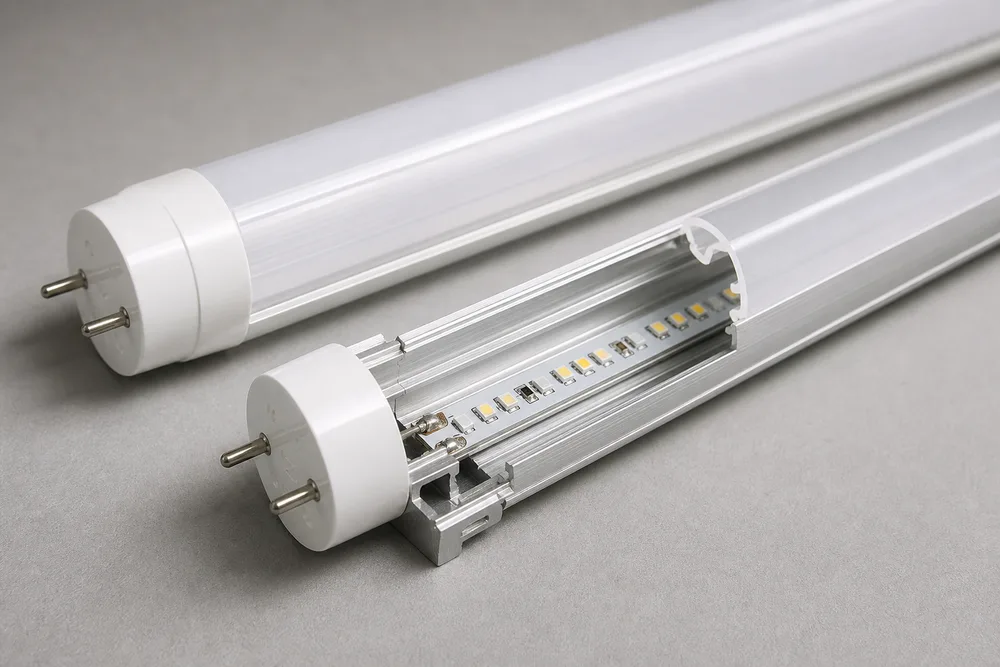
A T8 tube can look fine on a bench and still turn into a costly assembly problem once the PCB, driver, end caps and packaging meet the production line. The housing is where those parts have to agree. JE supplies an LED T8 plastic housing built around a PC outer tube or diffuser and a 6063 aluminum inner component, giving OEM and private-label tube-light assemblers a defined mechanical platform rather than a loose collection of parts.
The details are practical: a 26 mm outside diameter, compatibility with a 10 mm PCB board, frosted or clear PC diffuser choices, plastic end caps, and IP20 or IP65 configuration options. Lengths from 600 to 2400 mm are available, with custom lengths for projects that do not fit standard tube formats. Before asking for a price, establish the optical target, board layout, driver location and environmental requirement. Those four decisions determine whether the selected T8 housing is actually buildable.
Key Takeaways for T8 PC-and-Aluminum Housing Buyers
- This is a housing platform for LED tube assembly, not a finished lamp with LEDs, electronics and completed wiring.
- Confirm the 10 mm PCB-board fit, end-cap arrangement and driver placement before releasing an order.
- Frosted PC improves visual comfort; clear PC preserves a more direct LED appearance and higher visible point definition.
- IP20 and IP65 are different product configurations, not labels to add after the mechanical design is fixed.
- JE supports 600–2400 mm lengths and custom projects for OEM and private-label buyers.
The PC outer tube is the visible surface and the optical control layer. The internal aluminum piece does another job: it carries the LED board and provides the metal structure needed for a straight, serviceable tube assembly. Buyers who treat the aluminum as a generic insert often miss the issue that matters most in production—how the board, driver leads and end caps occupy the same internal space.
Start with the LED T8 PC outer tube and inner aluminum housing as a system. A diffuser decision changes the light appearance. An IP requirement changes sealing expectations. A driver in the end cap changes wiring clearance. None of these choices should be left for the factory to infer from a purchase order description.
FAQ: T8 Housing Compatibility, Diffuser Choice and IP Ratings
These are the questions that should be settled before samples are approved. A correct answer depends on the complete tube design, particularly the PCB, electronics, end-cap construction and intended installation environment.
Is this T8 housing a complete LED tube lamp or an extrusion component?
No. JE's T8 PC-and-aluminum housing is an extrusion-based component set for assembling an LED tube light. It includes the housing elements specified for the configuration, such as the PC outer tube or diffuser, 6063 aluminum inner component and plastic end caps. You still need to define and source the LED PCB, driver arrangement, electrical connections and the rest of the finished-lamp build. That distinction matters for quotations, compliance planning and responsibility for final product testing.
How do frosted and clear PC diffusers affect the finished LED tube?
Frosted PC diffusers soften the appearance of individual LED points and are normally selected where visual comfort matters more than seeing the LED pattern. Clear PC diffusers produce a more direct appearance and make the LED source more visible. Neither is universally better. Review both with the actual LED board and LED spacing you intend to use; a diffuser sample viewed without the final board can give a misleading impression of glare, brightness and uniformity.
IP20 is suited to protected indoor applications, while an IP65 version is intended for more demanding dust and water exposure. The rating is a completed-product issue, not a property of one extrusion alone. End caps, joints, cable entry and assembly controls all need to support the selected protection level.
T8 Housing Specifications and Configuration Points to Confirm Before Quotation
A useful quotation request identifies the mechanical interface first. JE lists a 26 mm diameter and compatibility with a 10 mm PCB board for this T8 housing. Those figures help define the starting point, but they do not replace confirmation of your board thickness, connector height, wire routing and LED placement. A board that is nominally the right width can still foul an end-cap feature or leave too little space for a soldered lead.
| Configuration point | JE reference offering | What you should confirm |
|---|---|---|
| Outer tube / diffuser | PC, frosted or clear | Light appearance, LED-point visibility and sample approval |
| Inner component | 6063 aluminum | PCB fit, internal clearance and thermal design of the finished lamp |
| Tube diameter | 26 mm | Fit with your end caps, fixtures and packaging concept |
| PCB compatibility | 10 mm board | Actual board width, thickness, components and lead exits |
| Length | 600–2400 mm or custom | Cut length, end-cap allowance and shipping constraints |
| Protection option | IP20 or IP65 | Full sealing design and required finished-product validation |
Driver placement is another early choice. JE indicates that the driver may be external or located in end caps. An external driver can free internal space, while an end-cap driver may suit a particular tube architecture. Neither arrangement is automatically easier; the right answer depends on your electrical layout, installation method and the space left after connectors and wiring are accounted for.
How to Specify a T8 PC Outer Tube and 6063 Aluminum Inner Component
Send a specification package that lets the supplier see the assembled product, not just the tube length. The recurring mistake is to request a T8 profile by diameter and then discover late in the project that the PCB, end cap or driver does not fit the selected construction. Your drawing should show the critical interfaces and identify which dimensions cannot move.
- Choose the optical face. State frosted or clear PC and provide the light-quality expectation you need to verify with a sample.
- Define the LED board. Confirm the 10 mm board compatibility and submit the actual board outline, thickness, component keep-out areas and wire exits.
- Set the tube length. Select a listed length from 600 to 2400 mm or provide the required custom finished length, including how end caps affect the overall dimension.
- Identify the driver architecture. Specify external-driver or end-cap-driver placement, then show connection details and available internal clearance.
- State the protection target. Name IP20 or IP65 and explain the intended environment so the end caps and sealing approach can be evaluated as part of the assembly.
- Request physical samples before production. Assemble your own PCB and accessories in the sample housing. This is where interference, loose engagement and unexpected light appearance show up.
For a production-ready reference, share photos or drawings of the mating end caps and the finished fixture. It is also sensible to inspect straightness, diffuser appearance and fit after the housing has been cut to your requested length. These are ordinary controls, but they prevent a cosmetic profile decision from becoming a line-stoppage problem.
JE Extrusion, OEM/ODM Support, Drawings, Accessories and Sampling Process
JE, Dongguan Jinen Lighting Technology Co., Ltd., manufactures plastic and aluminum extrusion components across tube housings, PC round tubes, diffusers, LED aluminum profiles, plastic profiles, end caps and tri-proof light housings. Its tube-housing range includes T5, T6, T8, T10 and T12 formats, which is useful if your private-label range needs more than one tube size with a consistent supplier relationship.
For non-standard work, JE offers custom extrusion and mold development: the process of converting a required plastic or aluminum cross-section into production tooling and an extruded profile that can be reviewed as a physical sample. In practical terms, that means the cross-section must account for wall geometry, board location, diffuser engagement, end-cap interfaces and the way the part will be cut and assembled. A drawing that only captures the outside shape is not enough. Internal features decide whether the profile can hold the board and close correctly.
Ask for the applicable drawing, accessory information and samples early. JE supports OEM/ODM customers, quotations and export buyers, so the most productive enquiry includes your target market, requested configuration and any packaging or labelling requirements. You can also review the published T8 housing construction and available options before preparing a drawing package.
Request T8 Housing Samples, Drawings and a Custom Quotation from JE:https://www.jeledprofile.com/contact.html
Send JE the information that changes the build: requested length, frosted or clear PC diffuser, 10 mm PCB details, driver location, end-cap needs and IP20 or IP65 target. Include a cross-section drawing if you have one, even if it is preliminary. A clear first enquiry gives the supplier a basis for checking fit and directing you to the right sample configuration rather than quoting an incomplete component list.
If you are developing a private-label lamp, specify what belongs to the housing request and what remains under your control. That prevents confusion over electronics, testing and final assembly. For a custom profile, mark critical dimensions and mating parts, then use the sample stage to assemble the exact board and accessories intended for sale. Approve the physical fit before committing to production tooling or volume quantities.
Start your T8 housing enquiry with the right build details
Request drawings, samples or a custom quotation for a PC outer tube and 6063 aluminum inner component. Include your PCB, diffuser, length, end-cap and IP requirements.
Visit Official Website →Use JE's contact page to send the drawing package and sample request. The fastest path to a useful quotation is a defined assembly, not a generic request for a T8 tube.