A tube light can look right in a catalog and still fail at assembly. The usual trouble spots are mundane: a PCB that is a fraction too wide for the channel, an end cap that does not match the finished extrusion, a driver arrangement that was never checked against the internal cavity, or a diffuser choice that creates more glare than the fixture application can tolerate. For U.S. lighting factories and project buyers, a LED tube housing should be reviewed as a mechanical system—not as a generic replacement part.
Key Takeaways for Shortlisting a LED Tube Housing Supplier
- Confirm the PCB width, diffuser profile, end-cap interface, and driver position before approving a housing.
- JE-29 is a round T8 housing with a 26 mm outside diameter and a 19 × 1 mm PCB board size.
- Its 6063 aluminum base and PC diffuser divide heat-management and light-distribution jobs between two materials.
- IP20 indicates an indoor, non-weatherproof housing; do not specify it for exposed wet or washdown locations.
- Ask for a sample and drawing review before committing to production quantities or a custom extrusion.
Start with fit, then move to appearance. Buyers often spend too much time comparing diffuser finishes before they have confirmed the board, driver, and end-cap stack-up. A supplier should be able to discuss the housing profile, available lengths, component interfaces, sampling path, and how a custom request changes tooling or production planning. For a production fixture, that conversation is more useful than a broad claim of “T8 compatibility.”
JE manufactures extrusion-based lighting components for tube, linear, cabinet, strip, tri-proof, and special-shape products. That breadth matters if your current round tube is only one member of a larger fixture family. Still, keep the approval scope disciplined: approve the actual LED tube housing configuration you intend to build, including the selected diffuser and caps.
JE-29 LED T8 Round Tube Housing: Specifications, Materials, and Compatibility Checks
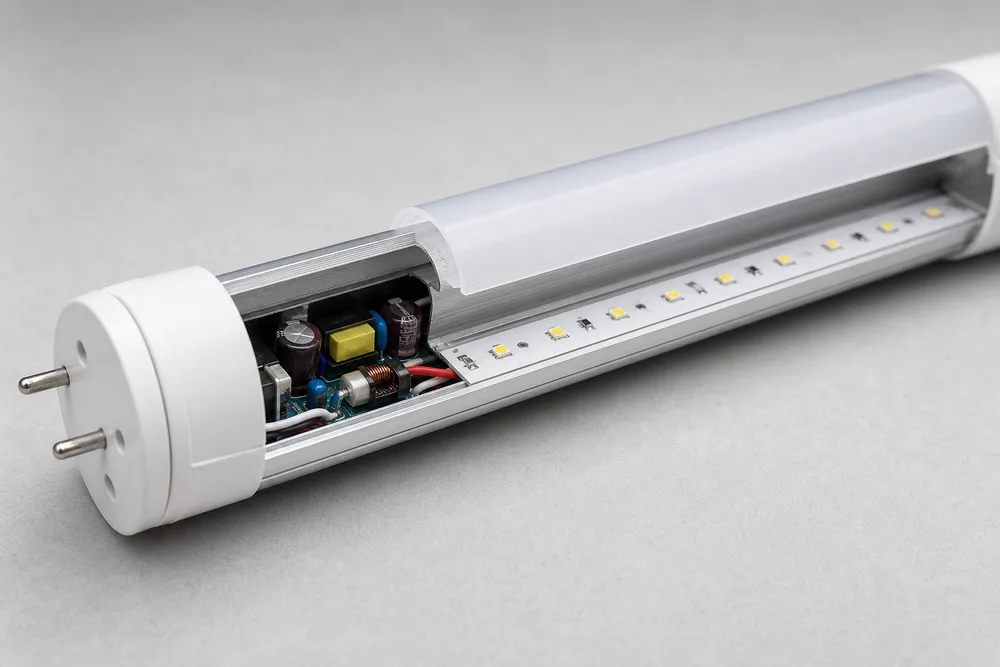
The JE-29 is a round LED T8 tube housing built in a half-aluminum, half-plastic format. Its stated outside diameter is 26 mm, and the stated PCB board size is 19 × 1 mm. The design uses an internal driver arrangement, so the driver must be reviewed against the available internal space and the intended wiring layout. This is not a detail to leave for final assembly. Driver body geometry, lead exit direction, and retention method can determine whether a tube closes cleanly or becomes an awkward hand-build.
| JE-29 feature | Stated configuration | What you should verify |
|---|---|---|
| Tube profile | Round LED T8 housing, 26 mm diameter | Clearance with your fixture, lamp holder, and packaging concept |
| PCB channel | 19 × 1 mm board size | Actual board outline, mounting position, and assembly tolerance |
| Base material | 6063 aluminum | Thermal contact strategy between the LED board and aluminum base |
| Diffuser | PC; clear, frosted, or stripe options | Desired glare, LED-point visibility, and visual finish |
| Protection rating | IP20 | Suitability for the actual indoor installation environment |
Clear PC can preserve a more direct appearance but may reveal individual LED points. Frosted PC generally softens that view, with the usual trade-off in transmitted light. A stripe diffuser is a visual design choice, not a substitute for confirming optical performance in your finished luminaire. Review the JE-29 LED T8 round tube housing against a physical board and end-cap set whenever the product will be sold under your own brand.
How to Specify and Source a LED Tube Housing: From Drawing Review to Forwarder Delivery
A clean sourcing process prevents expensive interpretation gaps between purchasing, engineering, and the factory. Send the application details with the first inquiry, rather than asking for a quote based on “T8 housing” alone. Standard and customized lengths are available, but length is only one requirement. Your supplier also needs to understand the diffuser choice, end-cap expectations, board arrangement, driver arrangement, and intended installation environment.
- Submit the mechanical package. Provide the board drawing, driver dimensions, wiring concept, desired finished length, and any critical interface dimensions.
- Review the profile drawing. Check the 26 mm round envelope, the 19 × 1 mm board requirement, diffuser engagement, and cap relationship before sampling.
- Choose the optical parts. Identify clear, frosted, or stripe PC based on the fixture’s visual target and test requirement.
- Approve a representative sample. Assemble it with your own board, driver, caps, and wiring—not with stand-in parts.
- Confirm commercial and shipping details. Put quantity, approved length, packing expectations, lead-time target, incoterm, and your nominated forwarder’s receiving instructions in the purchase record.
Do not treat a forwarder handoff as an afterthought. Long extruded parts can be damaged by poor packing or vague carton labeling even when the profile itself is correct. Your forwarder will need shipment-ready dimensions, weight information, pickup location, and document expectations from the supplier. Ask JE to confirm these details for the approved order rather than relying on estimates from an earlier sample inquiry.
JE’s Aluminum-and-PC Extrusion Approach for Standard and Custom LED Tube Housings
JE’s Aluminum-and-PC Extrusion Approach is the practical division of a tube housing into a 6063 aluminum base and a polycarbonate diffuser, with the parts designed to mate as one round assembly. The aluminum base provides the structural and heat-transfer path around the LED board area; the PC section forms the light-emitting cover and establishes the fixture’s visible finish. That material split is central to the JE-29 design. It is not merely a cosmetic aluminum trim paired with plastic.
6063 aluminum is widely used for extruded lighting profiles because it can be formed into consistent profile geometry. In a real fixture, though, the aluminum can only assist thermal management if the board contacts it as intended. Check board flatness, seating, fastening or bonding method, and any gap-producing features in your assembly. The diffuser needs its own attention: PC offers the diffuser options JE identifies, but a chosen lens finish should be validated on the actual LED layout.
JE offers public molds, private molds, OEM/ODM work, and custom extrusion. Custom work makes sense when a standard profile cannot accommodate your board, driver, optical requirement, or distinctive fixture shape. It also adds a drawing-approval and tooling decision that should be made early. For an established tube design, start by asking whether the standard JE LED tube housing profile already meets the mechanical brief. A standard profile can reduce the number of variables you must control.
LED Tube Housing FAQ: What Is Included, How Do You Confirm Fit, and What Are MOQ, Sampling, Lead-Time, and Certification Considerations?
What is included with the JE-29 housing?
JE identifies the JE-29 as a housing assembly with a 6063 aluminum base, PC diffuser, and plastic end caps. Confirm the exact bill of materials for your quote. Buyers should not assume that PCB assemblies, LED drivers, wiring, lamp holders, fasteners, or special packing are included unless they are written into the order. The selected diffuser finish and required length also need to appear on the approved specification.
How do you confirm fit before placing an order?
Match your board to the stated 19 × 1 mm PCB board size, then verify the driver against the internal arrangement and review the end-cap interface. A drawing review is the first gate; a hands-on sample build is the second. Assemble the sample with production-intent parts and check for board movement, diffuser seating, lead routing, cap closure, and any interference at the tube ends. That is where small mismatches show up.
What should you ask about MOQ, samples, lead time, and certifications?
MOQ, sample availability, sample timing, production lead time, and freight timing are commercial details that depend on the requested configuration and order. Request them in writing with your quantity, length, diffuser option, and any customization request. JE states an IP20 rating for this product; IP20 is not a claim of water protection. For certification needs, tell JE the market, finished-product standard, and documentation your project requires. A housing component and a completed luminaire are not automatically covered by the same compliance claim.
Request a JE-29 Sample, Custom Drawing Review, or B2B Quote
Send JE a concise package: your PCB drawing, driver outline, required tube length, diffuser preference, target quantity, destination, and any question about end caps or packing. If the project is a redesign, include photos of the current assembly and identify the failure you are trying to solve—hot board contact, poor diffusion, cap fit, or a profile that is too large for the fixture. That gives the engineering conversation a useful starting point.
For a standard JE-29 request, ask for the applicable drawing and a sample route before authorizing volume production. For a private mold or custom extrusion, identify the dimensions that are truly non-negotiable and those that can follow a standard manufacturing approach. You will get a better answer, faster, than by sending a generic request for a “custom T8 tube.”
Start with a JE-29 drawing or sample review
Share your board, driver, diffuser, length, and quantity requirements so JE can help confirm the right LED T8 round tube housing path.
Visit Official Website →