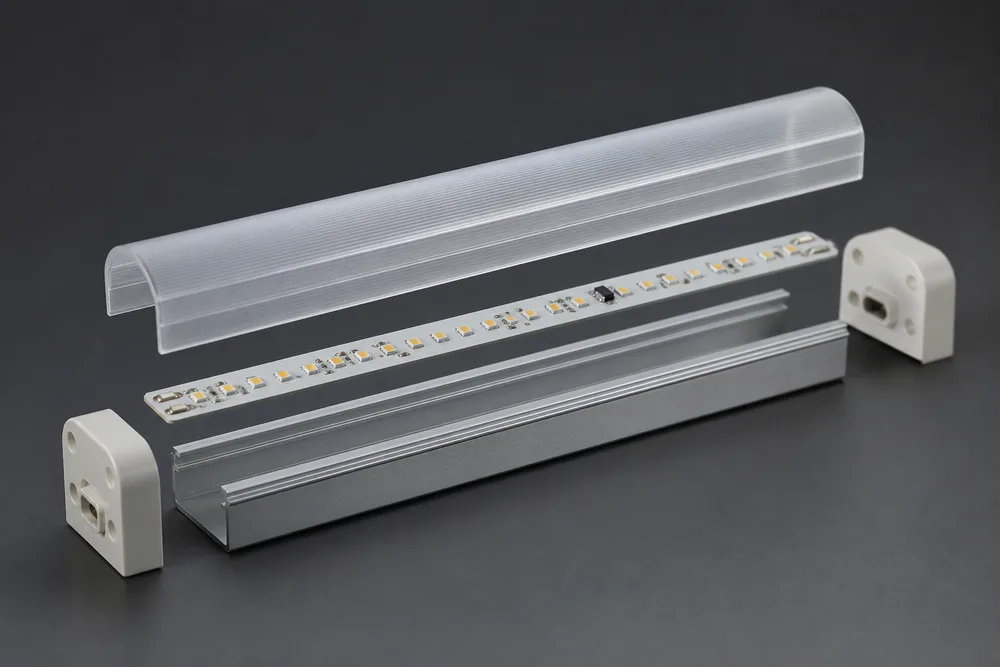
Key Takeaways for International T10 Tube-Housing Buyers
- JE-31 combines a polycarbonate diffuser with a 6063 aluminum base in a 30 mm T10-format housing.
- It is rated IP20, so it belongs in dry indoor luminaires rather than exposed wet or wash-down areas.
- Confirm PCB width, driver envelope, end-cap geometry and finished tube length before committing to production.
- Clear and frosted PC cover choices affect glare control and light appearance; neither is a detail to leave until final assembly.
- JE supports public-mold selection as well as private-mold and tooling discussions for custom extrusion work.
An LED tube housing is not merely an outer shell. It sets the mechanical reference for the LED PCB, controls how the diffuser sits, provides the aluminum path that helps manage heat, and determines what your line can assemble without rework. The JE-31 LED T10 tube housing is built around a PC cover and 6063 aluminum base, with room intended for an internal driver. That construction makes sense for OEM tube-light programs that need a defined, repeatable profile rather than a fully plastic tube.
Buyers often focus first on nominal tube format. The costly questions arrive later: does the board locate correctly in the aluminum channel, does the driver clear the cover and end caps, and can the selected cap complete the assembly without stressing the PC diffuser? Treat the housing, PCB, driver and cap as one mechanical system. A sample build is cheaper than sorting a batch of assemblies that will not close properly.
JE-31 LED T10 Tube Housing Specifications and Compatibility Table
JE identifies JE-31 as an LED T10 tube housing with a 30 mm diameter. Its visible cover is polycarbonate and is available in frosted or clear versions; the base is 6063 aluminum. Plastic end caps are part of the housing arrangement, and the profile has internal-driver space. Standard lengths and custom lengths are available for confirmation with JE. Those facts are useful starting points, but they do not replace a drawing review. “T10” is a format reference, not proof that any board, cap, driver or mounting arrangement will fit.
| Item | JE-31 detail and buyer check |
|---|---|
| Housing format | T10 LED tube housing; confirm the mating parts against the JE profile drawing. |
| Outside diameter | 30 mm. |
| Diffuser / cover | Polycarbonate cover, supplied in frosted or clear options. |
| Base material | 6063 aluminum base. |
| End treatment | Plastic end caps; verify cap style, fixing method and electrical-interface requirements separately. |
| Driver arrangement | Internal-driver space is provided; submit actual driver dimensions and wire exit details for fitment review. |
| Ingress protection | IP20, intended for protected indoor use. |
| Length | Standard or custom lengths should be confirmed during quotation. |
The clear-versus-frosted choice deserves an optical sample, not a quick purchasing decision. Clear PC can preserve a more direct view of the LED layout, while frosted PC is commonly selected where a softer appearance and reduced point-source visibility matter. The right choice depends on your LED pitch, board layout and intended visual standard. Review the PC cover and aluminum base configuration alongside a powered sample assembly.
Confirm Before Ordering: A Step-by-Step T10 Housing Fitment and RFQ Checklist
Most preventable tube-housing problems are interface problems. A PCB that is fractionally too wide, a driver with an awkward wire exit, or an end cap designed around a different extrusion can stop an otherwise sound project. Do not ask a supplier to judge fit from a generic product photo. Give them the physical inputs that define your assembly, then keep the approved sample as the production reference.
- Send the PCB drawing and a physical sample where possible. Include board width, thickness, LED-side clearance needs and how the board is fixed to the aluminum base.
- Provide the complete driver envelope. Show body dimensions, lead locations, wire exits and any insulating sleeves or connectors that increase the real occupied space.
- Specify the diffuser choice. State frosted or clear PC cover and confirm the visual target using a lit sample, particularly if individual LEDs must not be visible.
- Define finished length correctly. Clarify whether your dimension refers to the cut extrusion, the assembled housing, or the end-cap-to-end-cap tube length.
- Confirm end caps early. Check mechanical engagement, screw or retention approach where relevant, and the required lamp-holder or wiring interface.
- Request a fitment sample before mass production. Assemble it with your own PCB, driver and caps. Check cover closure, rattle, wire pinch points and assembly time.
- Put approved details into the RFQ. Identify profile, cover finish, length, cap selection, quantity, packaging expectations and any custom-tooling requirement.
This is particularly relevant for international purchasing. A housing can survive transit yet arrive with a mismatch that only appears on your line. Your RFQ should make clear which component JE supplies and which component you will source or install. That division of responsibility avoids the familiar dispute where every part is technically present, but the finished tube cannot be assembled.
IP20 T10 Housing Applications and When to Choose an IP65 Tri-Proof Alternative
JE-31 carries an IP20 rating. In practical terms, select it for protected indoor lighting assemblies where the fixture is not expected to resist water ingress. Typical projects can include dry commercial interiors, offices, retail displays, educational spaces and other enclosed indoor locations, subject to your finished luminaire design and local compliance requirements. The housing itself should never be presented as a wet-location solution simply because its cover and base appear tightly joined.
The distinction matters on site. Condensation, dust-heavy workshops, exterior canopies, food-processing wash-down areas and agricultural buildings all ask more from the enclosure than an IP20 tube housing is designed to provide. If your project calls for a sealed housing and higher ingress protection, assess an IP65 tri-proof alternative instead. The decision is not just about water. A tri-proof assembly changes end sealing, cable entry, gasket interfaces and service method. It may also change the profile, cap system and production sequence.
Do not use a field-applied sealant as a substitute for choosing the correct enclosure class. It can make service difficult, create inconsistent results between assemblers and still fail at cable exits. Tell JE where the luminaire will operate, how it will be installed and which ingress level the finished product must meet. That is the right basis for selecting between an indoor T10 profile and a tri-proof housing family.
JE OEM/ODM Extrusion Process for LED Tube Housings, PC Covers, End Caps and Custom Tooling
JE’s OEM/ODM extrusion process is the route by which a lighting manufacturer moves from an existing public profile or a new profile concept to an assembly-ready aluminum-and-plastic housing. It starts with the interface: the aluminum base must accept the board and driver plan, while the PC cover must lock to the base with a usable fit across the specified length. End caps are then assessed as part of the complete closure system, not as an afterthought.
For an established design, a public mold can shorten the path to sampling because the basic profile already exists. A private mold is appropriate when your product needs a proprietary cross-section, a particular board channel, a different cover geometry or an end-cap relationship that an available profile cannot support. Tool production should be discussed against actual drawings and assembly requirements. Changing a profile after tool release is not a minor cosmetic revision; it can affect the mating PC cover, end caps, packing and downstream assembly fixtures.
JE manufactures LED tube housings across T5, T8, T10 and T12 formats, as well as all-plastic, plastic-coated aluminum and aluminum-base/PC-cover constructions. That breadth is useful, but it should not tempt buyers to switch formats without revisiting the complete optical and mechanical stack. Share your target product, components and production volume, then ask for the most suitable public-mold option before opening a custom-tool discussion. You can start with the published JE T10 tube housing product details and submit the parts that must mate with it.
LED T10 Tube Housing FAQ and Request a Sample or Quote
The practical value of an LED T10 tube housing is proven at sample stage, not in a catalogue comparison. Ask for the profile information needed to evaluate your actual assembly, and keep questions specific: which cover option is being quoted, what length definition applies, which end cap is proposed, and what parts are excluded. If your customer requires a particular photometric appearance, submit a powered board rather than relying on a diffuser description alone.
For custom work, give JE a controlled drawing revision and identify the features that cannot change. Board seating, cover engagement and end-cap fit are usually functional features. Cosmetic requirements such as cover appearance, aluminum finish expectations and marking should also be written into the inquiry, but they should not obscure the fitment data that determines whether the tube can be built reliably. A sample assembled by your own production team remains the best check of real-world compatibility.
What components are included with the JE-31 T10 tube housing, and which should be confirmed separately?
JE-31 is described with a polycarbonate frosted or clear diffuser, a 6063 aluminum base, plastic end caps and internal-driver space. Confirm the exact PC cover selection, end-cap version, length and quantities in the quotation. You should also confirm separately whether LED PCBs, drivers, wiring, connectors, lamp interfaces, fasteners, packaging and any assembly service are included. Those items are application-specific and should never be assumed from the housing description alone.
How can buyers verify LED PCB, internal driver and end-cap compatibility before production?
Send dimensioned drawings and, preferably, representative physical samples of the PCB, driver and intended end caps. JE can then assess the profile interface and provide a housing sample for your own build test. Check how the PCB is retained against the aluminum base, whether the driver and wire exits clear the cover, and whether the cap closes without deforming or pinching components. Approve the assembled sample and document the selected parts before releasing a production order.
Send JE Your T10 Assembly Requirements
Prepare your PCB drawing, driver dimensions, required length, PC cover choice and end-cap requirement. Use those details to request a fitment sample or quotation for JE-31.
Visit Official Website →