A half-aluminum, half-plastic T12 LED tube housing gives an LED tube assembly two materials with two separate jobs: an aluminum base for the LED board and heat path, and a polycarbonate cover for diffusion and protection. For tube-light factories and OEM assemblers, that split matters more than appearance. It affects board fit, driver space, light distribution, end-cap selection, and the production checks needed before a run begins.
JE supplies this T12 housing construction with a 6063 aluminum base and PC diffuser for 38 mm tube formats. It can be specified with a clear or frosted cover and standard or custom lengths. The right choice is not simply “aluminum versus plastic.” It is confirming that the complete lamp design fits the housing from PCB to end cap.
A T12 Housing That Separates Heat Management From Light Diffusion
In a one-piece plastic tube, the body must handle mechanical protection, optical appearance, and the thermal demands of the LED assembly at once. A half-aluminum, half-plastic design divides those functions. The base carries the LED PCB and forms the structural lower half; the PC diffuser closes the tube and determines what the illuminated surface looks like.
That separation gives assemblers more control, but it does not eliminate design work. LED loading, the board-to-aluminum contact, driver placement, and the diffuser choice still determine how the finished tube performs. Housing material alone cannot compensate for a poorly matched PCB or an overcrowded internal driver.
How the 6063 Aluminum Base Supports Heat Dissipation
The 6063 aluminum base is the mounting surface for the LED board. Aluminum conducts heat away from the board more readily than a plastic-only body, providing a practical path for heat to leave the LED mounting area. The buyer outcome is a housing construction suited to LED tube designs that need an aluminum substrate beneath the PCB.
Check the real contact condition, not just the material name. A warped board, uneven adhesive application, or a board profile that does not sit properly on the base can reduce contact where it matters. Ask for the housing drawing, confirm the PCB profile, and review how your assembly process secures the board before committing to volume production.
How the Polycarbonate Diffuser Shapes Light Output and Appearance
The upper PC section is the diffuser. It protects the internal assembly while presenting the visible light-emitting surface. Clear and frosted covers are not interchangeable cosmetic details; they create different visual results and should be selected around the installation rather than by habit.
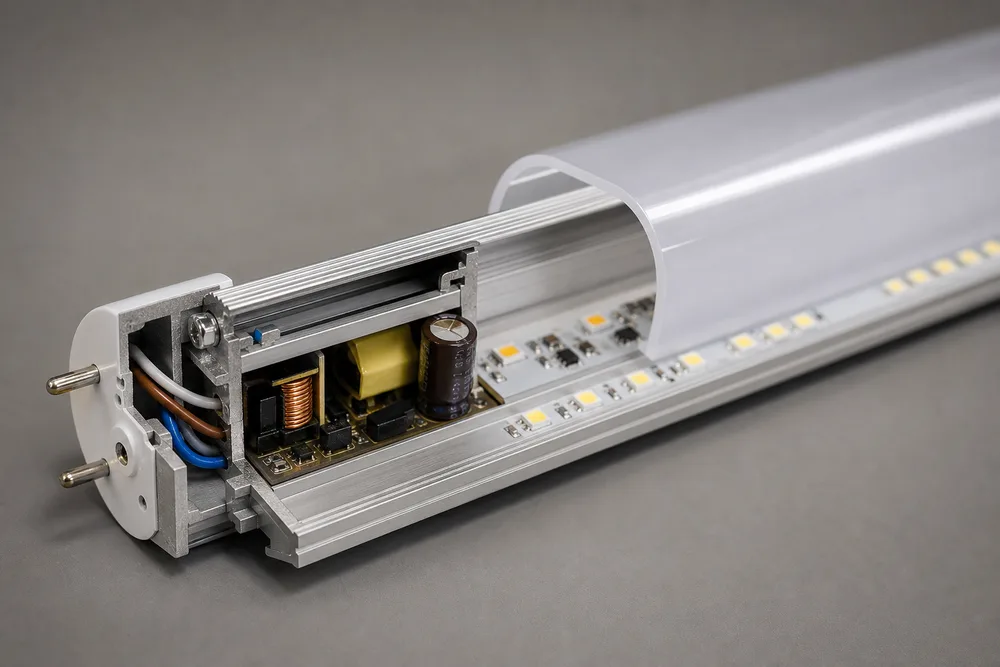
Polycarbonate is commonly used for tube diffusers because it can be extruded into the required cover shape. In this construction, the cover must also mate correctly with the aluminum base and work with the intended end caps. A loose fit can create assembly inconsistency. A cover that is difficult to install can slow the line and raise the chance of cosmetic damage.
Confirm Internal-Driver, PCB, End-Cap, and Tube Fit Before Assembly
A T12 tube housing is an assembly platform, not a finished lamp. JE’s featured T12 configuration is intended for an internal driver, so the driver envelope needs review alongside the LED board, wiring route, and end-cap layout. Do not approve a profile based only on outside diameter or a sample cover.
Key Fit Points for a 38 mm T12 Housing and 25.5 × 1.0 mm PCB Board
For a 38 mm T12 housing using a 25.5 × 1.0 mm PCB board, verify that the board matches the aluminum base seating area and that components do not interfere with the diffuser or internal driver. Confirm these points before tooling, purchasing, or line setup:
- PCB seating: The 25.5 × 1.0 mm board must sit as intended on the aluminum base without rocking, bending, or conflicting with profile features.
- Driver clearance: Measure the actual driver body, wire exits, and connections against the usable internal cavity. “Internal driver” does not mean every driver format will fit.
- End-cap compatibility: End caps must match the profile geometry and support the planned wiring and lamp-end arrangement.
- Finished length: Define whether the requested length refers to the extrusion, the complete lamp, or another production reference point.
These checks prevent a familiar problem: components that fit individually on the bench but cannot be assembled reliably once the diffuser and end caps are installed. Review JE’s half-aluminum, half-plastic T12 LED tube housing details against your actual bill of materials.
Choose a Clear or Frosted PC Diffuser for the Intended Lighting Effect
A clear PC diffuser is appropriate where a more direct view of the internal LED arrangement is acceptable or desired. A frosted PC diffuser is generally chosen when the lamp needs a softer-looking illuminated surface and less visible LED point detail. The correct decision depends on LED spacing, output target, viewing distance, and the visual standard of the installation.
Do not assume frost automatically solves visible dotting. Board layout and LED spacing still influence what users see through the cover. Likewise, a clear cover may be suitable in a fixture or installation where the tube itself is not viewed at close range. Request samples and evaluate them with your selected LED board, not with an unrelated demo assembly.
Indoor Applications for an IP20 T12 LED Tube Housing
This JE T12 construction is rated IP20. That places it in indoor applications where protection against water exposure is not required. The rating should guide the project decision early, before a tube housing is approved for a location with washdown, rain, condensation, or heavy dust concerns.
Where Stores, Offices, Classrooms, Showrooms, Auditoriums, and Supermarkets Benefit
Stores, offices, classrooms, showrooms, auditoriums, and supermarkets can be suitable settings for an IP20 T12 LED tube assembly when the full fixture and installation conditions align with the project requirements. In these environments, buyers often care about a clean tube appearance, consistent diffuser selection, and repeatable assembly across multiple lengths or production batches.
For OEM programs, the practical benefit is flexibility around the finished lamp design. JE offers standard and custom lengths, and its wider tube-housing range supports manufacturers looking to keep a familiar extrusion supplier across product families. If the project needs a custom-length T12 tube housing, establish the cut length, end-cap allowance, and packaging requirements together rather than treating them as separate decisions.
When an IP20 Half-Aluminum Housing Is Not the Right Construction
Do not use an IP20 tube housing as a substitute for a protected industrial or outdoor luminaire. Locations exposed to water jets, weather, frequent moisture, or conditions requiring a higher ingress-protection level need a housing and complete fixture system designed for that duty.
This construction may also be the wrong fit if your PCB is substantially different from the stated 25.5 × 1.0 mm format, if the driver cannot occupy the internal space without stressing wires or the diffuser, or if the lamp needs a different tube diameter. For those cases, a different public mold or a custom-mold review is more sensible than forcing incompatible components into a T12 profile.
T12 Housing Sourcing Checklist: Length, Diffuser, Compatibility, and Custom Tooling
- Confirm that a 38 mm T12 tube format matches your lamp and fixture plan.
- Match the 25.5 × 1.0 mm PCB board requirement to your LED board design and base contact area.
- Verify internal-driver dimensions, wire routing, and end-cap compatibility using production components.
- Select clear or frosted PC based on the light appearance you need from the finished tube.
- Keep IP20 housing use to appropriate indoor conditions.
- Define standard or custom length using the complete assembled lamp as the reference.
- For a nonstandard design, discuss JE OEM/ODM or custom-mold options before finalizing the electronics.
Use the JE T12 aluminum-base PC-cover housing page to request the relevant profile information, samples, or a quotation based on your assembly requirements.