- English
- Español
- Português
- русский
- Français
- 日本語
- Deutsch
- tiếng Việt
- Italiano
- Nederlands
- ภาษาไทย
- Polski
- 한국어
- Svenska
- magyar
- Malay
- বাংলা ভাষার
- Dansk
- Suomi
- हिन्दी
- Pilipino
- Türkçe
- Gaeilge
- العربية
- Indonesia
- Norsk
- تمل
- český
- ελληνικά
- український
- Javanese
- فارسی
- தமிழ்
- తెలుగు
- नेपाली
- Burmese
- български
- ລາວ
- Latine
- Қазақша
- Euskal
- Azərbaycan
- Slovenský jazyk
- Македонски
- Lietuvos
- Eesti Keel
- Română
- Slovenski
- मराठी
- Srpski језик

LED T8 Tube Housing with 10mm PCB: US Buyer FAQ, Fit Checks and Sourcing Guide for 2026
Key Takeaways
- The JE-28 is a 26 mm T8 LED tube housing designed around a 10 x 1.2 mm PCB and an internal driver arrangement.
- Its standard configuration uses a 6063 aluminum base, polycarbonate diffuser options, plastic end caps, and an IP20 rating.
- Do not specify the standard JE-28 for wet locations, freezer interiors, or outdoor parking areas without confirming a separate waterproof housing variant.
- Fit checks should cover PCB width, driver height, diffuser clearance, end-cap retention, tube length, and the final assembled electrical design.
- JE supplies samples, quotations, custom lengths, OEM/ODM extrusion support, and shipment to a US customer’s forwarder warehouse.
Key Takeaways for US Lighting Buyers
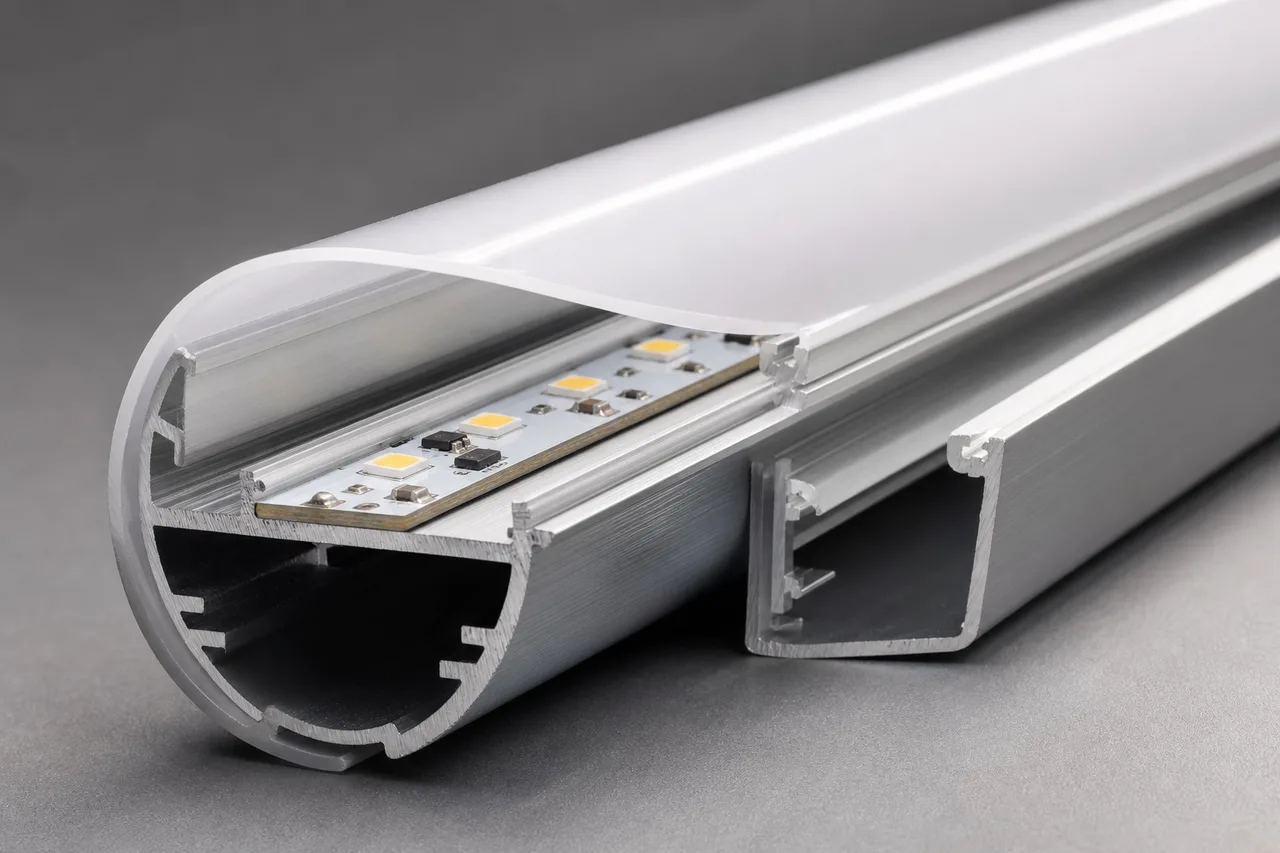
The phrase JE semi-aluminum/semi-plastic tube-housing construction describes the practical architecture behind this product category: a 6063 aluminum base carries the LED board and helps manage heat, while a polycarbonate diffuser forms the visible optical cover. That division matters. Aluminum gives the PCB a stable mounting surface and a predictable mechanical backbone; the diffuser controls appearance, light transmission, and access to the board. It is not simply a decorative shell.
For US buyers, the first question is not price. It is compatibility. A 10 mm PCB is narrower than many generic LED tube boards, and the driver must fit inside the housing without pressing against the diffuser or interfering with the end caps. The JE-28 is listed with a maximum driver height of 12 mm, so your driver body, wiring, insulation, and strain-relief details should be checked together rather than separately.
The standard JE-28 is IP20. That makes it suited to dry indoor luminaires and retrofit-style tube assemblies, not automatically to washdown areas or exposed fixtures. JE also offers waterproof tube-housing styles for applications such as plant lighting, refrigerator lighting, and outdoor parking, but those should be quoted as the appropriate waterproof configuration. Start with the JE LED T8 tube housing with 10mm PCB specification and ask for the exact drawing before approving a production order.
JE-28 LED T8 Housing Specifications: Dimensions, Materials and Configuration Options
The JE-28 is a 26 mm T8 housing built for a 10 x 1.2 mm PCB board size. That dimension is the starting point for mechanical qualification. A board that is nominally 10 mm wide can still create problems if its component height, solder joints, connector placement, or mounting method differs from the sample used during housing development.
The housing uses a 6063 aluminum base with polycarbonate diffuser options and plastic end caps. JE lists an internal driver arrangement and a maximum driver height of 12 mm. Available lengths run from 600 mm to 2400 mm, with custom lengths available. Length, diffuser finish, end-cap style, and driver position should be treated as a single assembly decision because each affects installation, light distribution, and packing.
| Parameter | JE-28 information | What US buyers should confirm |
|---|---|---|
| Housing type | LED T8 tube housing | Complete assembled tube design and installation method |
| Housing diameter | 26 mm | Compatibility with the intended T8 fixture, clips, and end caps |
| PCB requirement | 10 x 1.2 mm PCB board size | Board outline, component height, connectors, and mounting details |
| Base material | 6063 aluminum | Surface finish, board attachment, and thermal interface |
| Diffuser | Polycarbonate options | Clear or frosted finish, optical target, and color consistency |
| Driver arrangement | Internal driver | Driver dimensions, heat, wiring, and electrical approvals |
| Maximum driver height | 12 mm | Actual driver height including insulation and wire routing |
| Standard rating | IP20 | Use a separately specified waterproof version for wet or exposed locations |
| Length range | 600 mm to 2400 mm or custom | Cut tolerance, end-cap allowance, carton length, and project quantities |
How to Qualify a T8 Housing Before Ordering: PCB, Driver, Diffuser and End-Cap Checks
A housing can look correct on a catalog page and still fail during assembly. The usual causes are not dramatic: a driver is a few millimeters too tall, the PCB bows under the diffuser, the end cap does not retain the tube securely, or a connector leaves no room for the internal wire bend. Qualify the complete assembly, not only the aluminum extrusion.
- Confirm the PCB outline. Send JE the actual board drawing, including the 10 mm width, 1.2 mm thickness, mounting holes, copper keep-outs, connectors, and tallest components. Do not rely on the nominal board size alone.
- Check the driver envelope. Compare the driver’s maximum height and width with the 12 mm housing limit. Include terminals, heat-shrink, insulating sleeves, and wire exits in the clearance review.
- Inspect the diffuser fit. Test the selected polycarbonate cover for engagement, bowing, visible hotspots, and removal force. A diffuser that is too tight can stress the extrusion; one that is too loose can rattle during transport.
- Review end caps and wiring. Confirm cap material, retention method, wire passage, connector access, and whether the finished tube must meet a specific installation standard or customer fixture interface.
- Approve a finished sample. Power the assembled tube, inspect heat behavior and light appearance, then test insertion into the target fixture or clips. Record the approved component versions before placing the production order.
Ask for the extrusion drawing and a physical sample when the project has tight fixture clearances. A sample also exposes packaging and handling issues that drawings do not show. Long tubes can arrive with diffuser marks, end-cap damage, or slight bowing if the carton design is not matched to the shipping length. Those are inexpensive to fix before mass production and expensive to fix after a US distribution shipment.
FAQ: Is the JE-28 LED T8 Tube Housing Waterproof or Suitable for Outdoor and Freezer Lighting?
The standard JE-28 specification supplied by JE is IP20, so it should be treated as a dry-location housing. That distinction is critical for buyers specifying plant lighting, refrigerator lighting, outdoor parking, or any installation exposed to condensation, spray, dust, or temperature cycling. JE states that it offers waterproof T8 housing styles for special applications, but the waterproof version must be identified and quoted separately.
Will a 10 mm PCB and Internal Driver Fit This T8 Tube Housing?
Yes, the JE-28 is specified for a 10 x 1.2 mm PCB and an internal driver arrangement, with a maximum driver height of 12 mm. That does not mean every 10 mm board and every internal driver will fit. Your board’s tallest LED, capacitor, connector, and soldered wire must stay within the available internal clearance. Send JE the PCB file and driver datasheet for a fit review, then verify the result with a populated sample.
How Do Samples, MOQ, Custom Lengths, Tooling and Shipping to a US Forwarder Work?
JE states that it can provide samples, quotations, custom lengths, OEM/ODM extrusion, and shipment to a customer’s forwarder warehouse. The commercial details depend on the selected profile, diffuser, end caps, tooling status, quantity, packaging, and destination arrangement. Ask for the sample lead time, production MOQ, tooling charge if a private mold is needed, cut-length tolerance, carton dimensions, and the documents supplied with the shipment. If your team uses a US forwarder, provide the warehouse address and cargo-marking requirements before the quote is finalized.
JE Dongguan Manufacturing, OEM/ODM Extrusion and Finished-Luminaire Documentation
JE, formally Dongguan Jinen Lighting Technology Co., Ltd., manufactures extruded LED lighting components in Dongguan, China. Its range includes LED aluminum profiles, LED plastic profiles, PC tubes and diffusers, T5, T6, T8, T10, and T12 tube housings, plus tri-proof light housings. That product breadth is useful when a project changes size or construction after the first prototype. A buyer can compare a semi-aluminum housing, a full aluminum base, or a different tube diameter through the same supplier rather than restarting the entire sourcing process.
JE supports public molds, private molds, OEM/ODM extrusion, and custom project work. Public-mold sourcing can make sense for a standard JE-28 geometry when the profile already matches your PCB and diffuser requirements. A private mold becomes more defensible when you need a nonstandard connector pocket, a different mounting feature, a proprietary end cap, or a revised cross-section. The right choice depends on expected volume and how much control you need over future supply.
For US importers and lighting factories, documentation should cover more than a product photo. Request the profile drawing, material description, diffuser option, length tolerance, end-cap specification, packing details, and the electrical information for the completed luminaire. The housing itself is not the same thing as a certified finished LED tube. If your customer, AHJ, distributor, or project specification requires particular listings or compliance documents, identify that requirement before the design is frozen.
JE also states that it serves wholesalers, contractors, lighting factories, and custom-project customers. That makes the supplier a fit for both component purchasing and private-label tube development, provided the commercial scope is written clearly. Put the approved drawing, sample photos, revision number, and material choices on the purchase documentation. It prevents a familiar problem in extrusion sourcing: a replacement batch that is dimensionally close but not actually interchangeable.
Request a JE-28 Sample, Drawing or Quote for Your US Lighting Project
Send JE your PCB drawing, driver dimensions, target tube lengths, diffuser preference, end-cap requirements, application conditions, estimated quantity, and US shipping or forwarder details. Ask the team to confirm the standard IP20 configuration or recommend the correct waterproof housing for the installation.
Visit Official Website →