The right LED tube housing is the one that fits your assembly first, then survives the environment it will work in. Start with the PCB, driver position, end caps, required length, and mounting method. Only after those checks should you decide between a PC cover with an aluminum base, an all-plastic tube construction, or an IP65 tri-proof housing.
Buyers often begin with T5, T8, T10, or T12 because the format is familiar. That is useful, but it is not enough. A nominal tube format does not confirm the internal space, cover profile, end-cap fit, or how the finished lamp will be mounted. Those details determine whether production moves cleanly or stops at final assembly.
Start With the Application, Environment, and Assembly Requirements
Define the operating conditions and assembly route before choosing the housing. A dry indoor replacement tube, a cabinet light, and a wash-down-area fixture may all use LED tube-shaped components, but they need different housing construction and sealing decisions.
The Short Answer: Match the Housing Construction to the Light’s Use and Required Protection
Use a PC cover and aluminum base where heat handling, rigidity, and a conventional tube-light assembly matter. Choose an LED plastic tube housing or round PC tube where the design calls for a lighter all-plastic construction and the thermal load is appropriate for that build. Move to an IP65 tri-proof housing when the fixture needs a protected enclosure rather than a basic indoor tube body.
Ask practical questions early: Will the light be surface-mounted or suspended? Does the driver sit inside the tube, in an end-cap area, or outside the housing? Is the light likely to see dust, splashes, cleaning, vibration, or repeated handling? A housing that looks right on a sample bench can become the wrong choice once clips, cable entry, and production assembly are involved.
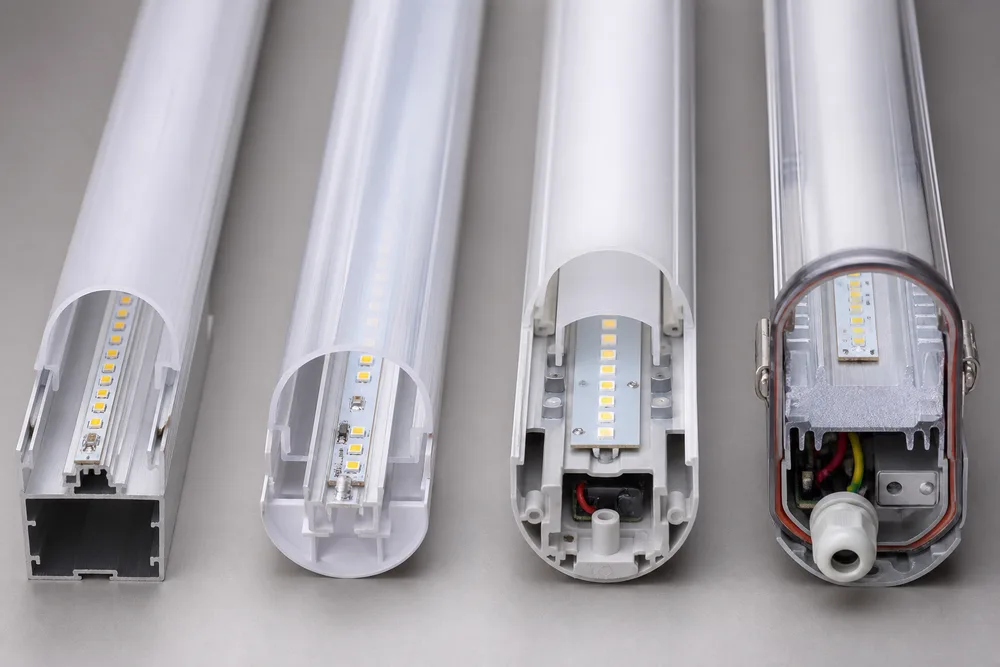
Compare LED Tube Housing Constructions Before Selecting a Format
Construction is the decision point that changes material behavior, assembly sequence, and the parts you must source. The outside diameter alone tells you very little about how a tube light goes together.
PC Covers and Aluminum Bases for Tube-Light Assembly
A housing with a PC cover and aluminum base separates the optical and structural roles. The cover shapes and diffuses the emitted light, while the aluminum section provides the base for the LED assembly and adds stiffness to the finished product. This construction is commonly considered for T8 LED tube housing projects and other tube-light formats where the mechanical relationship between the board, base, cover, end caps, and clips must be controlled.
Do not treat every PC cover as interchangeable. Its profile must mate correctly with the aluminum base, and its optical finish should suit the intended light appearance. A diffuser may reduce direct view of LED points, while a clearer cover may preserve a different visual effect. The choice should be confirmed with the actual LED layout and sample assembly, not selected from a product photo.
Plastic Tube Housings, Round PC Tubes, and Diffuser Options
All-plastic constructions can be appropriate where the product architecture is designed around plastic extrusion or a round PC tube. The important check is not simply whether the tube is PC; it is whether the tube, internal LED assembly, end caps, and mounting arrangement were designed to work together.
Round PC diffuser tubes are also a distinct choice from shaped covers fitted over an aluminum base. Their internal clearance, cap interface, and intended assembly method may differ. If you are comparing LED plastic tube housing options against composite PC-and-aluminum designs, send the same PCB, driver, end-cap, and mounting information to both suppliers. That prevents a false comparison based on appearance alone.
Confirm PCB, Driver, End-Cap, and Length Compatibility Before Quotation
Confirm the full assembly stack before asking for a price. This is where many otherwise suitable LED tube housings fail: the PCB does not sit as intended, the driver has no realistic location, the end caps do not match the profile, or a requested custom length changes the cut and assembly plan.
A quote-ready request should identify the tube format you are considering, such as T5, T6, T8, T10, or T12, but also state the actual profile or sample reference. Include the PCB outline and placement, driver dimensions and location, end-cap type, cable or connector needs, mounting clips, target length, and required quantity. If a cover and base are separate parts, make that explicit.
What to Include in a Drawing or Sample Request
- A cross-section drawing or a physical reference sample.
- PCB width, thickness, and how it is intended to sit in the housing.
- Driver envelope, wire routing, and end-cap connection details.
- The required PC cover style, including the desired diffuser appearance.
- Finished length, end-cap arrangement, clips, and mounting orientation.
- The operating environment and any need for a tri-proof enclosure.
- Expected order quantity, sample requirement, and destination or forwarder details.
JE supports samples, custom lengths, end caps, clips, drawings, and shipment to a customer’s forwarder. For a starting point on available constructions, review its LED lighting extrusion range before sending the build details. A drawing is preferable to a verbal description; a section mismatch is expensive to discover after tooling or a production run has started.
When an IP65 Tri-Proof Housing Is the Better Choice
An IP65 tri-proof housing is the better choice when the fixture needs the protected enclosure associated with that rating, rather than an open or lightly protected tube-light construction. It should be assessed as a system: housing body, PC cover or diffuser, end caps, sealing features, cable entry, and final assembly all affect the result.
Do not specify IP65 as a label to add at the end. If the installation will face moisture, dust, or regular cleaning, establish the protection requirement before selecting the profile and end-cap design. Also check how the finished light will be mounted and serviced. A sealed-looking sample is not proof that the assembled fixture meets the required level of protection.
JE lists IP65 tri-proof light housings alongside tube housings and plastic and aluminum LED profiles. Share the actual use conditions with the supplier so the correct enclosure route can be considered instead of adapting an indoor tube housing beyond its intended job.
Should You Choose a Public Mold or Develop a Custom LED Tube Housing?
Choose a public mold when an existing profile fits your assembly, appearance, and commercial plan. Choose custom LED tube housing development only when a standard section leaves a real problem unresolved: a PCB cannot be located correctly, the driver needs a different cavity, the end-cap interface is unique, the cover geometry is part of the product identity, or the mounting arrangement requires it.
Public molds usually reduce the development path because the base profile already exists. The trade-off is compromise. You may need to accept an available cross-section, cover style, or component arrangement. Private-mold OEM/ODM development gives you control over the section, but it requires a settled drawing, tooling discussion, and agreement on ownership and confidentiality. Changing the profile after tooling starts is not a minor revision.
JE states that it offers standard public molds and private-mold development supported by plastic extrusion, aluminum extrusion, injection molding, mold processing, and testing equipment. Ask directly about tooling, samples, MOQ, lead time, and confidentiality agreements. Those commercial details should be discussed alongside the drawing, not after a profile has been approved.
Send a Quote-Ready Brief to a China LED Tube Housing Manufacturer
A useful brief gives the manufacturer enough information to judge fit, not just enough to name a tube size. State your application, preferred construction, tube format or section reference, PCB and driver arrangement, cover requirement, end caps, clips, finished length, protection needs, sample request, and order expectation. Attach drawings wherever possible.
If you are sourcing from a China LED tube housing manufacturer, ask what is covered by an existing public mold and what would require new tooling. Then compare samples using your real PCB, driver, and caps. That is the check that matters.
Ready to turn the requirement into a manufacturable assembly? Send your drawing or sample details through JE’s LED tube housing contact route and request the appropriate public-mold or custom-mold option.