- English
- Español
- Português
- русский
- Français
- 日本語
- Deutsch
- tiếng Việt
- Italiano
- Nederlands
- ภาษาไทย
- Polski
- 한국어
- Svenska
- magyar
- Malay
- বাংলা ভাষার
- Dansk
- Suomi
- हिन्दी
- Pilipino
- Türkçe
- Gaeilge
- العربية
- Indonesia
- Norsk
- تمل
- český
- ελληνικά
- український
- Javanese
- فارسی
- தமிழ்
- తెలుగు
- नेपाली
- Burmese
- български
- ລາວ
- Latine
- Қазақша
- Euskal
- Azərbaycan
- Slovenský jazyk
- Македонски
- Lietuvos
- Eesti Keel
- Română
- Slovenski
- मराठी
- Srpski језик

How to Engineer LED Housings for High-Vibration Rail Environments
Rolling stock is a hostile environment for electronics. Every time a train hits a track switch, high-frequency kinetic energy travels from the bogies up through the chassis and directly into the ceiling panels. When transit authorities complain about flickering cabin lights or dead overhead fixtures, the problem is rarely the LED chip itself. The failure almost always traces back to the mechanical enclosure.
An LED Rail Vehicle light housing is not just a decorative cover. It is a structural shock absorber, a thermal management system, and a primary life-safety barrier. If the extrusion design fails to account for harmonic resonance, thermal expansion, or transit fire codes, the lighting system will fail long before its rated lifespan. Designing for this environment requires abandoning standard commercial lighting assumptions and engineering specifically for constant, violent motion.
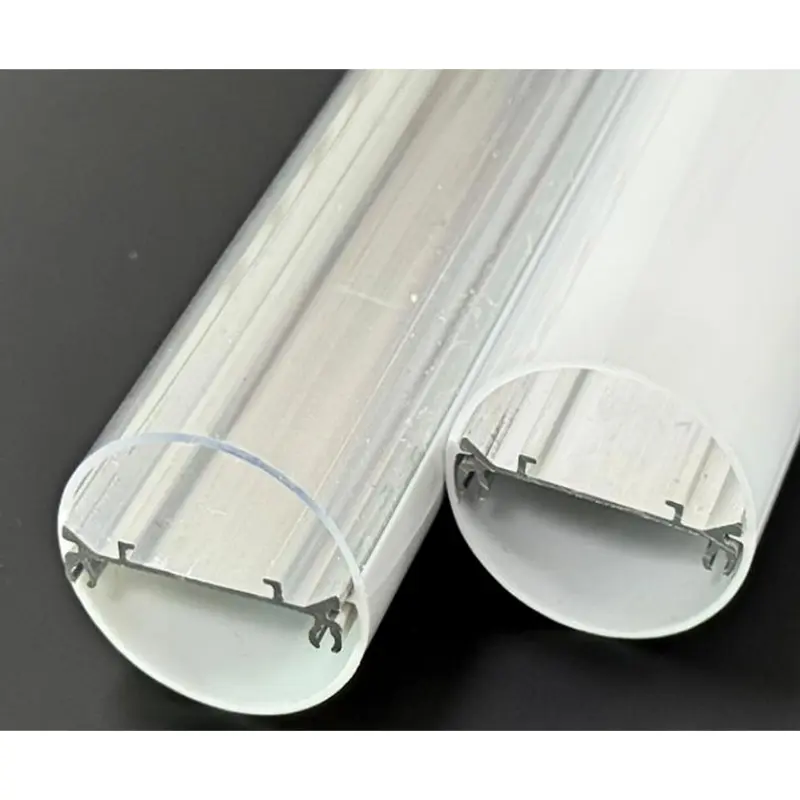
Diagnosing Mechanical and Thermal Failures in Rolling Stock Lighting
To design a better housing, you first have to understand exactly how current designs break down in the field. Rail environments subject lighting fixtures to a compounding mix of physical shock, extreme temperature swings, and confined airspace. When a housing is poorly engineered, the symptoms usually present in three distinct failure modes.
Solder Joint Micro-Cracking
The most common cause of flickering train lights is mechanical fatigue. When an aluminum LED extrusion is mounted rigidly to a vibrating ceiling panel without proper damping, the housing transfers that kinetic energy directly to the internal PCB. The constant flexing causes micro-cracks in the solder joints connecting the diodes to the board. Buyers often blame the PCB manufacturer, but the root cause is a housing that lacks internal shock-isolation for the LED tray.
Polycarbonate Crazing and Diffuser Ejection
Trains undergo severe thermal cycling. A passenger car parked in a rail yard overnight might drop below freezing, then rapidly heat up when the HVAC and lighting systems power on. Aluminum and plastic expand at different rates. If the mechanical tolerances between the aluminum base and the plastic diffuser are too tight, the thermal expansion creates immense stress. This causes "crazing"—a network of microscopic cracks in the polycarbonate—or worse, causes the diffuser to buckle and pop out of its track during a sudden braking event.
IP65 Seal Compression Set
Subway cars require aggressive cleaning regimens, often involving high-pressure washing. To survive this, a vibration resistant LED transit light housing needs a reliable IP65 rating. However, constant vibration causes inferior gasket materials to flatten out over time, a phenomenon known as compression set. Once the seal loses its memory, moisture and cleaning chemicals bypass the housing, shorting out the electrical components.
Material Selection Criteria for EN45545 Compliance and Vibration Damping
Specifying materials for rail lighting requires balancing structural rigidity with strict passenger safety mandates. You cannot simply use off-the-shelf commercial extrusions. Every component must pass stringent rail standards, most notably EN45545, which governs fire behavior and materials in railway vehicles.
The Base Profile: 6063-T5 Aluminum
For the main structural extrusion, 6063-T5 aluminum is the industry standard. The T5 temper provides the exact mechanical properties needed for an aluminum LED extrusion for rolling stock: it is rigid enough to span the length of a train car ceiling without sagging, yet ductile enough to endure low-frequency vibrations without fracturing. Crucially, 6063 aluminum offers excellent thermal conductivity, acting as a highly efficient heat sink for high-output LED strips.
The Diffuser: Flame Retardant Polycarbonate (PC)
When it comes to the optical cover, standard PMMA (acrylic) is too brittle for rail applications. A heavy impact will shatter it, creating hazardous shards. Standard ABS is cheap but fails the smoke and toxicity requirements of transit fire codes.
You must specify flame-retardant PC (polycarbonate). PC can withstand direct impact without shattering, making it ideal for high-traffic public transit. More importantly, custom formulations of PC can meet EN45545 Hazard Level 3 (HL3) requirements. This means in the event of a cabin fire, the housing will not propagate the flame, and the smoke emitted will remain below the strict toxicity thresholds required to ensure passengers can safely evacuate.
Gasketing and End Caps
Avoid standard PVC or cheap rubber for end-cap seals. EPDM or high-grade silicone is mandatory. These materials resist temperature extremes and UV degradation while maintaining their compressive rebound, ensuring the IP65 rail vehicle LED fixture enclosure remains watertight after years of daily vibration.
Validating Heat Dissipation with AI-Driven Thermal Simulation
Heat is the enemy of LED longevity. In a commercial office, an LED fixture sheds heat into open ambient air. In a high-speed train, the lighting housing is often recessed into an insulated ceiling panel directly beneath a massive, heat-generating HVAC duct. The ambient temperature surrounding the fixture is already elevated, drastically reducing the delta-T (temperature difference) needed for effective cooling.
Before cutting expensive tooling for a new extrusion profile, thermal management must be validated digitally. Modern engineering workflows now use AI-assisted thermal simulation software to model exactly how heat moves through the housing in a confined space.
The simulation models the thermal pathway from the LED diode, through the thermal paste, into the PCB, and out through the 6063-T5 aluminum fins. AI-driven solvers can rapidly iterate hundreds of fin geometries—adjusting the thickness, spacing, and angle of the heat sink—to find the exact configuration that maximizes surface area without adding unnecessary weight. Weight is a critical metric in rail vehicle design; heavy housings increase the overall mass of the train, driving up energy consumption. By validating the heat dissipation digitally, engineers can design a thermal management rail LED housing that keeps the diode junction temperature below 80°C while minimizing the mass of the aluminum profile.
Design for Manufacturability (DFM) in Custom Aluminum and Polycarbonate Profiles
Even the most optimized CAD model is useless if it cannot be reliably manufactured at scale. Extruding aluminum and plastics requires precise control over material flow, cooling rates, and die friction. Dongguan Jinen Lighting Technology (JE) operates 20 plastic and 5 aluminum extrusion lines, providing DFM support to catch structural flaws before the tooling phase.
When engineering a custom LED rail vehicle light housing, follow these specific DFM actions:
- Balance Wall Thicknesses: Ensure the cross-section of your aluminum profile has uniform wall thickness. Thick sections cool slower than thin sections. If a heavy mounting flange sits next to a thin heat-sink fin, the uneven cooling will cause the profile to warp or twist as it exits the extrusion die. Keep thickness transitions gradual.
- Design Generous Snap-Fit Tolerances for PC: Polycarbonate shrinks as it cools. When designing the interlocking tracks where the PC diffuser snaps into the aluminum base, calculate the thermal expansion coefficients for both materials. Leave a precise expansion gap. If the fit is too tight, the PC will bow outward when the train heats up.
- Engineer Deep Gasket Channels: An IP65 rating requires more than just compressing a piece of silicone. Design a dedicated, U-shaped retention channel into the aluminum extrusion. The channel walls must be deep enough to mechanically lock the gasket in place so it cannot roll or shift under lateral vibration.
- Minimize Hollow Cavities in Plastic Profiles: Hollow sections in plastic extrusions require complex, expensive dies with internal mandrels. Where possible, design the PC cover as a single-wall profile with supporting ribs rather than a closed tubular section. This reduces tooling costs and speeds up production on the extrusion line.
Aligning OEM Extrusion Capabilities with US Transit Procurement Standards
Bringing a rail lighting fixture to the US market requires navigating a complex web of procurement specs, from localized FTA guidelines to rigid safety certifications. US transit authorities evaluate bids based on long-term reliability and compliance, which shifts heavy responsibility onto the lighting manufacturer and, by extension, their component suppliers.
Sourcing standard commercial extrusions will lead to failure during the shock, vibration, and fire-testing phases. You need an OEM partner whose manufacturing baseline already aligns with transit-grade requirements. JE supplies OEM lighting manufacturers globally, offering both public molds for standard applications and private molds for proprietary, high-spec designs.
By partnering with a manufacturer that inherently understands the tolerances required for 6063-T5 aluminum and EN45545-compliant polycarbonate, you eliminate the trial-and-error phase of product development. You get housings that snap together cleanly, seal tightly, and survive the relentless mechanical abuse of the rail environment. For technical specifications on custom profiles or to review existing transit-ready molds, evaluate a proven OEM subway lighting housing manufacturer that can deliver the precise mechanical foundation your next transit project demands.