- English
- Español
- Português
- русский
- Français
- 日本語
- Deutsch
- tiếng Việt
- Italiano
- Nederlands
- ภาษาไทย
- Polski
- 한국어
- Svenska
- magyar
- Malay
- বাংলা ভাষার
- Dansk
- Suomi
- हिन्दी
- Pilipino
- Türkçe
- Gaeilge
- العربية
- Indonesia
- Norsk
- تمل
- český
- ελληνικά
- український
- Javanese
- فارسی
- தமிழ்
- తెలుగు
- नेपाली
- Burmese
- български
- ລາວ
- Latine
- Қазақша
- Euskal
- Azərbaycan
- Slovenský jazyk
- Македонски
- Lietuvos
- Eesti Keel
- Română
- Slovenski
- मराठी
- Srpski језик

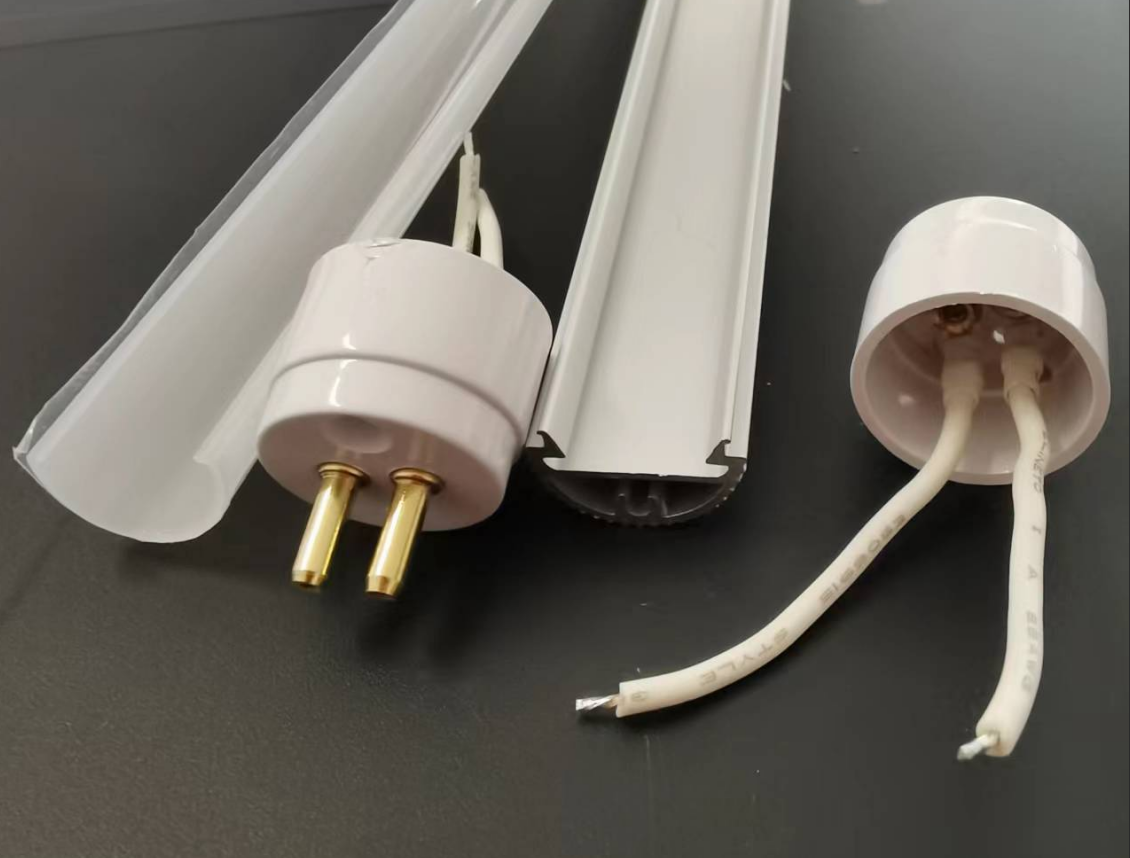
G5 End Cap Wiring
First, please clarify: what exactly do you mean by "wire"?
In the manufacturing process of T5 and G5 LED tubes, "single-wire/multi-wire/wireless" usually refers to the number of wires leading from the end cap, not the power supply method of the tube itself (single-ended/double-ended power supply). These two concepts are easily confused.
- Single-wire: The end cap leads out only one wire, usually the live wire (L) or neutral wire (N).
- Multi-wire (double-wire): The end cap leads out two wires, usually one live wire and one neutral wire.
- Wireless: The end cap itself does not lead out any wires; there are only two G5 pins.
Once this is clarified, the subsequent combinational logic is easy to understand.
Combination 1: One End Single-wire + One End Wireless → Single-ended Powered Tube
This is the most common configuration for T5 integrated LED tubes on the market.
Connection method: Power is only supplied from the single-wire end. This single wire connects to either the live or neutral wire, while the other wire (live or neutral) is directly connected to a pin at the other end via the internal circuitry of the lamp tube. At the wireless end, one pin is responsible for mechanical fixation and conductivity, while the other pin may be unconnected or internally short-circuited.
However, there is a critical manufacturing detail: the pin spacing of the T5 G5 lamp holder is only 5 mm. When one end is powered, the two pins are very close together, and improper internal wiring can easily cause a short circuit. Therefore, the insulation and wiring layout inside the single-wire end cap is a key indicator of the end cap supplier's craftsmanship.
Application Scenarios: Office lighting, supermarket shelf lights, cabinet lights, display case lights. These types of lamps typically use an integrated bracket, requiring only one power input, simplifying installation, and end users do not need any electrical knowledge.
Combination Two: One Wire from Each End → Double-ended Powered Lamp Tube
This method is common in engineering renovation projects.
Connection Method: Lead a wire from the lamp caps at both ends of the lamp tube. Connect one end to the live wire (L) and the other end to the neutral wire (N). Current flows in from one end and out from the other. The two G5 pins inside the lamp cap are shorted, forming a single electrode.
Why is dual-ended power supply preferred in engineering? When retrofitting old fluorescent lamp holders, the original G5 holders are usually connected in parallel, meaning the two pins are internally short-circuited. Dual-ended lamps can be directly adapted to this type of holder without needing to be replaced with a non-parallel holder. If a single-ended lamp is installed in a parallel holder, it will short-circuit immediately upon power-on. This has happened in the Hong Kong engineering community; some even burned the plastic casing of the old holder.
Production Precautions: Both ends of the dual-ended lamp cap should have leads, but the wire colors must be clearly distinguishable (e.g., one end marked L, the other N) to avoid reverse wiring during installation. Furthermore, the internal wiring of the dual-ended fluorescent lamp must ensure there is no electrical connection between the two ends; otherwise, the lamp will short-circuit.
Application Scenarios: Factory workshops, parking lots, warehouses, and logistics centers. These locations often require the retrofitting of old fluorescent lamp holders, and dual-ended power supply solutions offer better compatibility.
Combination 3: One End with a Live Wire (Dual-wire) + One End with a Wireless End Cap → Enhanced Single-ended Power Supply
This combination is an enhanced version of single-ended power supply, suitable for scenarios with higher safety and reliability requirements.
Connection Method: The power supply end cap leads out the live and neutral wires, directly connecting to the driver power supply or AC power. The wireless end is only used for mechanical support and circuit connection, and does not handle power input.
Difference from Single-Wire Single-Ended Solution: In the single-wire single-ended solution, the internal wiring of the lamp tube requires a design of "one wire entering, and another wire connecting internally to the other end," making the internal wiring relatively complex. In contrast, in the dual-wire single-ended solution, both the live and neutral wires are introduced through the same end cap, thus achieving a more direct internal circuit design, reducing potential failure points, and improving safety.
Production Advantages: For integrated T5 lamp tube manufacturers, this method offers higher assembly efficiency than using single-ended end caps. Because all power cords are concentrated at one end, there is no need for cross wiring inside the lamp tube, thus reducing the risk of internal short circuits.
Applications: Medical lighting, educational lighting, high-end commercial displays.
About JE
JE is a factory specializing in the production of LED tube end caps.
For more details, please refer to:
For more details, please contact: sales@jeledprofile.com
Tel/Whatsapp/Wechat: 0086 13427851163