- English
- Español
- Português
- русский
- Français
- 日本語
- Deutsch
- tiếng Việt
- Italiano
- Nederlands
- ภาษาไทย
- Polski
- 한국어
- Svenska
- magyar
- Malay
- বাংলা ভাষার
- Dansk
- Suomi
- हिन्दी
- Pilipino
- Türkçe
- Gaeilge
- العربية
- Indonesia
- Norsk
- تمل
- český
- ελληνικά
- український
- Javanese
- فارسی
- தமிழ்
- తెలుగు
- नेपाली
- Burmese
- български
- ລາວ
- Latine
- Қазақша
- Euskal
- Azərbaycan
- Slovenský jazyk
- Македонски
- Lietuvos
- Eesti Keel
- Română
- Slovenski
- मराठी
- Srpski језик

The Ultimate 2026 Guide to LED T8 Plastic Tube Housing: Navigating US UL/ETL Standards & Eco-Polycarbonate Innovations
Key Takeaways & Executive Summary
- Rigorous US Standards: Compliance with 2026 UL94 V-0 flame-retardant and ETL requirements is non-negotiable for commercial architectural lighting.
- Proprietary Extrusion Tech: The T8-PolyShield Precision Transmittance Protocol achieves up to 92% light transmittance without hot spots.
- Engineered Fitment: Tailored precisely for 12*1mm PCBs with a built-in power supply configuration.
- Eco-Responsible Design: Transitioning to recyclable, UV-stabilized polycarbonate cuts carbon footprint while extending durability.
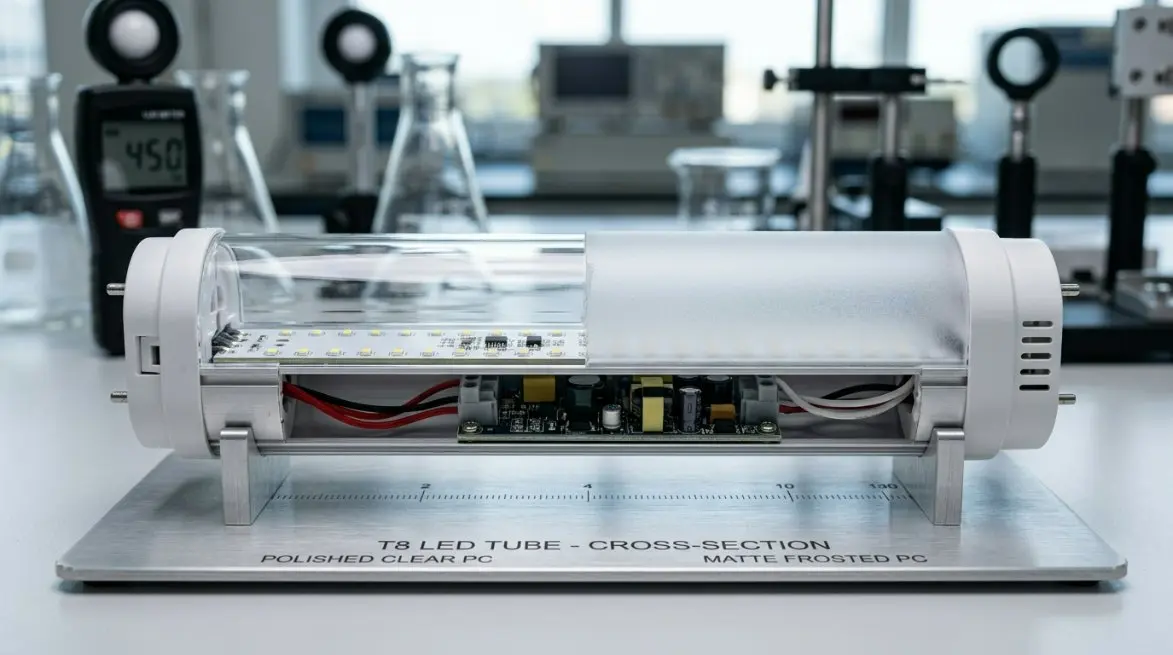
Proprietary Innovation: Introducing the T8-PolyShield Precision Transmittance Protocol
As an industry-leading OEM & ODM LED T8 plastic tube housing manufacturer, JE has been at the forefront of the plastic extrusion industry since 2017. Our latest breakthrough, the T8-PolyShield Precision Transmittance Protocol, represents a massive leap forward in lighting efficiency and visual comfort. By employing molecularly aligned, high-grade polycarbonate with advanced light-diffusing agents, this technology eliminates pixelation and "hot spots" common in low-tier LED retrofits.
The T8-PolyShield Precision Transmittance Protocol works by structuring the internal micro-prism layer during the co-extrusion phase. This ensures that light emitted from the internally mounted 12*1mm PCB is dispersed evenly across a 240-degree beam angle. This protocol maximizes luminous efficacy while keeping glare parameters well within the comfort levels demanded by US commercial workspace regulations.
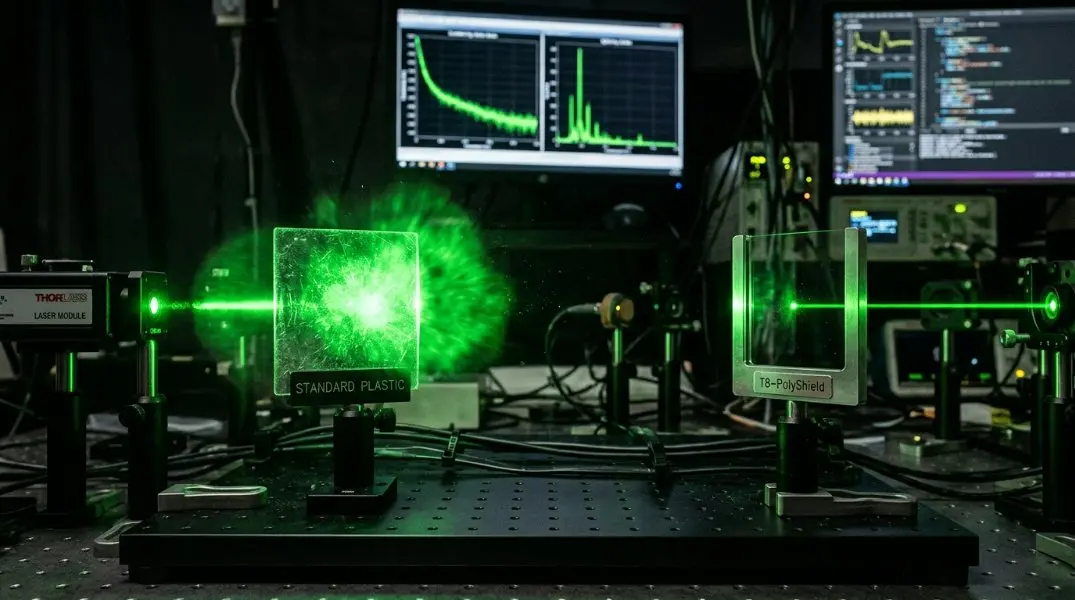
Addressing the US Compliance Gap: 2026 UL/ETL Fire-Retardant Standards & The Shift to Recyclable Polycarbonate
In the United States, commercial building codes are becoming increasingly stringent regarding fire safety and sustainability. Traditional acrylic and low-grade plastics no longer meet the upgraded UL 94 V-0 flame-retardancy standards required for commercial luminaire listings. When procuring LED T8 plastic tube housing products, North American engineers must ensure materials are self-extinguishing within 10 seconds of flame application and prevent flaming drips.
JE resolves this bottleneck by utilizing premium, UL-certified, eco-friendly polycarbonate formulations. These housings are not only fully recyclable—helping projects qualify for US LEED certification—but also offer superior resistance to thermal degradation and yellowing under UV exposure. By integrating our housings, US lighting brands can seamlessly clear ETL testing phases, reducing time-to-market for complex retrofit initiatives.
Technical Comparison Matrix: Standard PC vs. High-Transmittance Eco-Friendly Polycarbonate Housing
Understanding the exact material differences is crucial for mechanical and electrical engineers. Below is a comprehensive comparison breakdown:
| Specification Parameter | Standard Polycarbonate Cover | JE High-Transmittance Eco-PC |
|---|---|---|
| Optical Transmittance (Frosted) | 78% - 83% | 88% - 92% |
| UL 94 Flammability Class | V-2 Rating | V-0 Rating (Self-Extinguishing) |
| Yellowing Index (YI) after 5000h UV | > 5.0 | < 1.5 |
| PCB Compatibility Slot | Varying dimensions | Strict 12*1mm Tolerances |
| Thermal Conductivity | 0.18 W/m·K | 0.24 W/m·K (Optimized) |
Data-Driven Specification Guide: Optical Clarity, CE, RoHS, and FCC Compliance
For custom municipal and enterprise bids, compliance verification is a mandatory step. Our LED T8 plastic tube housing options undergo rigorous lab-testing protocols to ensure global compliance. They meet CE and RoHS directives for hazardous substance restriction and satisfy FCC Part 15 Class B emissions limits when integrated with a compliant built-in driver. This ensures no electromagnetic interference with modern Wi-Fi or medical networks in enterprise environments.
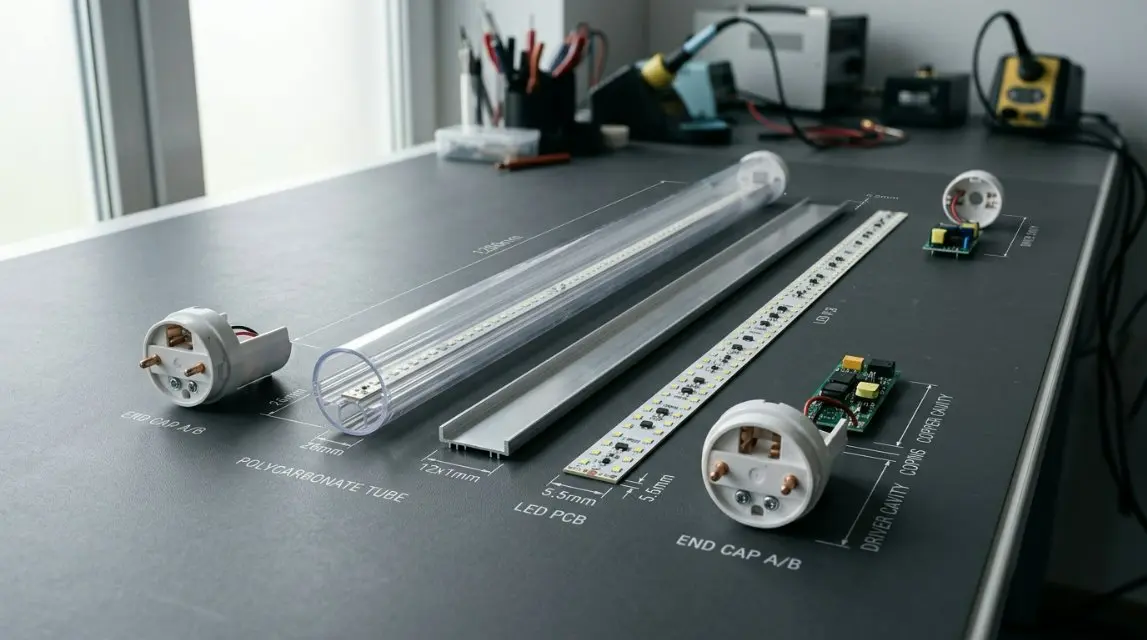
Step-by-Step Tutorial: Seamless Installation & 4-Step IP67/IP68 Waterproof Resealing
Achieving moisture protection in wet-rated commercial setups requires a systematic sealing protocol. Follow this precision deployment checklist:
-
Step 1: Precision Cutting to Specific US Architectural Tolerances
Use a fine-tooth circular saw or an automated extrusion cutter running at a controlled speed of 1200 RPM to execute straight-cut edges. The tolerance margin for high-end US applications must not exceed ±0.5 mm to ensure flawless end cap seating.
-
Step 2: Integrating the LED Strip and Applying Industry-Grade Thermal Sealant
Slide the prepared 12*1mm aluminum PCB board into the internal slot. Apply a consistent line of high-viscosity, non-corrosive neutral RTV silicone thermal adhesive along the bottom guide rail to anchor the PCB and optimize conductive thermal transfer.
-
Step 3: Securing End Caps for Complete IP67/IP68 Flex Certification Integrity
Thread the power supply input lines through the pre-drilled G13 or custom pin end caps. Inject a continuous bead of high-performance waterproof silicone adhesive into the inner collar of the end cap, then firmly press it onto the PC tube housing.
-
Step 4: Final Curing, Safety Inspection, and Thermal Testing
Allow the assembled tube to cure in a temperature-controlled chamber (75°F / 24°C with ~50% humidity) for a full 24 hours. Run a standardized dielectric withstand test (Hipot) and thermal camera scan before final installation.
Mathematical Guidance: Calculating Thermal Dissipation & Power Supply Load for Custom T8 Lengths
When operating high-brightness chips on a standard 12*1mm board within a restricted, built-in driver layout, maintaining a low junction temperature is critical to avoiding rapid lumen degradation.
Exact Wattage Calculations and Safe Power Supply Formulas per Meter
Use the industry-standard formulas below to calculate continuous power safe loads and avoid thermal runaway within the enclosed polycarbonate housing profile:
Calculated Safe Heat Dissipation Capacity (P_max):
P_max = k * A * (T_j - T_a) / d

Where:
- k  = Thermal Conductivity of JE Eco-PC (~0.24 W/m·K)
- A  = Outer Heat Dissipation Area of T8 Housing (m²)
- T_j = Maximum allowable LED Junction Temperature (typically < 85°C / 185°F)
- T_a = Ambient Temperature of installation environment (°C)
- d  = Polycarbonate wall thickness of the extrusion profile (m)

Maximum continuous electrical load rule:
P_electrical_max = P_max * 1.25 (Assumes 80% driver efficiency offset)
Ensure linear power density does not exceed 15 Watts/meter without continuous air-flow or aluminum backing strips.
Frequently Asked Questions (FAQ): Smart Home Integration & Safety Tolerances
Are LED T8 Plastic Tube Housings compatible with Smart Home ecosystems like the Matter standard, Apple HomeKit, and Amazon Alexa?
Yes. The housing material is fully passive and constructed of 100% radio-frequency transparent polycarbonate. Unlike heavy aluminum profiles, it does not attenuate or block signals from built-in Wi-Fi, Bluetooth Mesh, Zigbee, or Matter-enabled drivers tucked into the interior power chamber. This ensures clear smart home wireless connectivity across long distances.
What are the exact cutting tolerances and cutting intervals per meter for custom LED T8 integrations?
For custom OEM/ODM orders, our extrusion lines operate at an extremely tight tolerance of ±0.3 mm up to 4-foot lengths (1200mm). The cutting interval is fully customizable according to your custom PCB layout requirements. However, standard US applications recommend 1-inch (25.4mm) physical increments to align with standard luminaire retrofitting troffers.
How do 2026 UL/ETL safety instructions affect commercial installations and fire-retardant material compliance?
Under the updated 2026 guidelines, commercial lighting retrofits must feature housings that do not propagate fire or release toxic heavy gases under extreme thermal strain. JE's specialized LED T8 plastic tube housing models rely on high-grade flame-retardant resins that easily secure field-installation approval by municipal electrical inspectors.
Looking for Custom Engineering/OEM Solutions?
As a top-tier professional manufacturer, we deliver direct factory-price solutions for dynamic scaling, engineering projects, and custom systems globally.
Visit Official Website →