- English
- Español
- Português
- русский
- Français
- 日本語
- Deutsch
- tiếng Việt
- Italiano
- Nederlands
- ภาษาไทย
- Polski
- 한국어
- Svenska
- magyar
- Malay
- বাংলা ভাষার
- Dansk
- Suomi
- हिन्दी
- Pilipino
- Türkçe
- Gaeilge
- العربية
- Indonesia
- Norsk
- تمل
- český
- ελληνικά
- український
- Javanese
- فارسی
- தமிழ்
- తెలుగు
- नेपाली
- Burmese
- български
- ລາວ
- Latine
- Қазақша
- Euskal
- Azərbaycan
- Slovenský jazyk
- Македонски
- Lietuvos
- Eesti Keel
- Română
- Slovenski
- मराठी
- Srpski језик

LED Tube Housing: The Hidden Factor That Determines Long-Term Lighting Performance
It took me so many years to figure out that the LED Tube Housing is the key factor that truly determines whether a lamp is good to use or not.
If you had asked me ten years ago what the most important factor was when choosing LED light tubes, I would have answered without hesitation: the LEDs themselves, brightness, and lumen output.
If you were to ask me the same question now, I might chuckle first and then give you a seemingly counterintuitive answer: the LED tube housing.
Yes, it's that thing that is often overlooked and dismissed as nothing more than a “shell.”
The reason I became so fixated on it is simple: reality taught me a hard lesson.
That “failed” project was the first time I truly took LED Tube Housing seriously.
A few years ago, I was involved in a lighting upgrade project for a commercial space. The plan looked perfect.
The LED tubes were solid, the specs were impressive, and installation went smoothly.
The problem showed up six months later.
The lights started turning yellow, brightness became uneven, and a few tubes even showed slight deformation. The client stayed polite, but the look in his eyes said it all: “Didn’t you say these would last for years?”
Honestly, that look hurt more than a direct complaint.
After digging through everything, we found the issue wasn’t the LEDs or the driver.
It was the LED tube housing.
The material quality was mediocre, the heat dissipation design was sloppy, and the diffuser aged shockingly fast.
Since then, I’ve completely changed one habit:
I look at the housing first, and only then do I talk about the lamp itself.

What Is LED Tube Housing Actually Responsible For?
When most people hear the word “housing,” they picture a simple layer of plastic wrapped around a light.
In real-world use, LED tube housing plays a much bigger role. It acts as:
- The structural framework of the tube
- A critical part of the cooling system
- The behind-the-scenes director of light quality
- The gatekeeper of long-term stability and lifespan
Put simply:
Whether a lamp performs well and lasts depends heavily on whether the housing can truly hold everything together.
I’ve seen far too many products that look identical on the outside but perform very differently once installed.
From the surface, most LED Tube Housing designs look almost the same.
The real differences hide in details you don’t notice at first glance.
1. Full PC Housing: Lightweight, but Don’t Expect It to Carry Heavy Loads
The advantages of PC housings are obvious:
- Lightweight
- Low cost
- High light transmission
The downsides are just as obvious:
- Limited heat dissipation
- Tendency to yellow over time
- Average stability at higher power levels
I usually describe it as a “sprinter.”
Use it in the right scenario, and it performs fine. Push it into the wrong role, and its weaknesses show up fast.
2. All-Aluminum Housing: Built Like a Truck, but Not Exactly Gentle
I have zero doubts about aluminum when it comes to heat dissipation.
In warehouses and factories, aluminum LED tube housings are absolute workhorses.
But aluminum has a personality flaw:
It doesn’t understand optics.
If the diffuser design isn’t right, the light ends up harsh or uncomfortable.
That’s why all-aluminum structures make more sense in functional environments than in comfort-driven spaces.
3. Aluminum + PC Structure: The One I Trust the Most
If I had to choose a long-term partner, this would be it.
An aluminum base paired with a PC diffuser.
The aluminum handles heat and strength.
The PC diffuser makes the light look good.
This structure isn’t about showing off. It’s about avoiding problems.
The first time I saw this approach clearly broken down in technical materials related to Jinen, I remember nodding.
It felt like something designed by people who had been on-site, made mistakes, and learned the hard way.
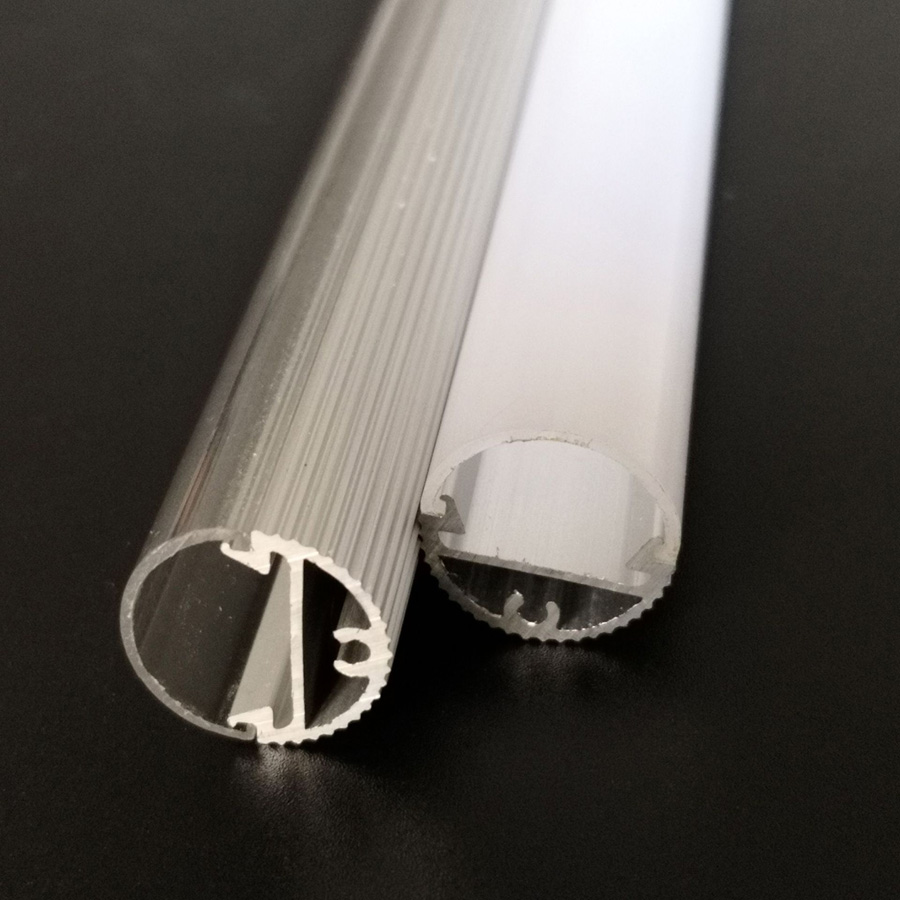
The Diffuser Isn’t Decoration. It’s the Mood Setter.
Here’s something people don’t always like to hear:
The same light, with a different diffuser, can feel completely different.
I ran a simple comparison:
- Transparent cover: very bright, very glaring
- Milky diffuser (opal cover): comfortable, slightly lower brightness
- Prismatic cover: balanced, ideal for offices and commercial spaces
A good LED tube housing ensures the diffuser fits perfectly.
No light leakage. No dust buildup. No looseness.
With poor-quality housing, it doesn’t take long before you notice:
- Yellowing edges
- Warped diffusers
- Light that suddenly feels “irritated”
Installation and Maintenance Are the Real Adult Problems
Lights don’t disappear once they’re installed.
A truly mature LED Tube Housing design always considers:
- How it will be taken apart later
- What happens when the driver fails
- Whether the diffuser can be replaced independently
I’ve seen too many designs that tried to save a single screw and ended up shortening the entire product’s life.
Experience taught me a very simple rule:
A light that’s easy to maintain is the one that actually saves money.
Different Spaces, Different Priorities
Office Spaces
- Glare control matters more than maximum brightness
- Diffuser uniformity is critical
Commercial Spaces
- Messy housing lines ruin the overall look
- Light must stay stable, not flicker between bright and dim
Industrial and Warehouse Settings
- Heat dissipation, strength, and durability come first
- Aluminum thickness is not a place to cut corners
Choosing LED Tube Housing is really about choosing how well it fits the application.

Why I Look at the Housing Before the Spec Sheet
Because I finally understood one thing:
The LED determines how high you can fly.
The housing determines whether you crash halfway.
I’ve seen plenty of lamps with beautiful spec sheets.
I’ve seen far fewer that still perform reliably years later.
And the good ones all share one thing in common:
Their housings were never an afterthought.
Final Thought
LED Tube Housing is one of those characters that never steals the spotlight, yet quietly decides the ending.
If you only plan to use a light for a year, almost anything will do.
If you want it to work quietly for years, spend time looking at the housing.
It doesn’t crave attention, but it controls the outcome.
Some professionals don’t need to shout.
Some quality speaks only through time.
And I only learned to respect these “small details” after failing enough times myself.