- English
- Español
- Português
- русский
- Français
- 日本語
- Deutsch
- tiếng Việt
- Italiano
- Nederlands
- ภาษาไทย
- Polski
- 한국어
- Svenska
- magyar
- Malay
- বাংলা ভাষার
- Dansk
- Suomi
- हिन्दी
- Pilipino
- Türkçe
- Gaeilge
- العربية
- Indonesia
- Norsk
- تمل
- český
- ελληνικά
- український
- Javanese
- فارسی
- தமிழ்
- తెలుగు
- नेपाली
- Burmese
- български
- ລາວ
- Latine
- Қазақша
- Euskal
- Azərbaycan
- Slovenský jazyk
- Македонски
- Lietuvos
- Eesti Keel
- Română
- Slovenski
- मराठी
- Srpski језик

Advantages of IP65 LED T8 Integrated Housings for Commercial Assembly
Assembly lines lose time on minor misalignments. When you are building commercial lighting fixtures by the thousands, the housing is not just a protective shell. It dictates your entire production cadence. A poorly extruded profile forces operators to use excessive pressure during assembly, introduces micro-cracks in the diffuser, and ultimately leads to water ingress during field operation. Getting the mechanical housing right is the single highest-leverage decision an OEM makes before soldering a single diode.
For commercial and industrial lighting builders, specifying the correct LED T8 integrated housing shifts the burden of weatherproofing and thermal management away from the assembly floor and into the fundamental geometry of the part.
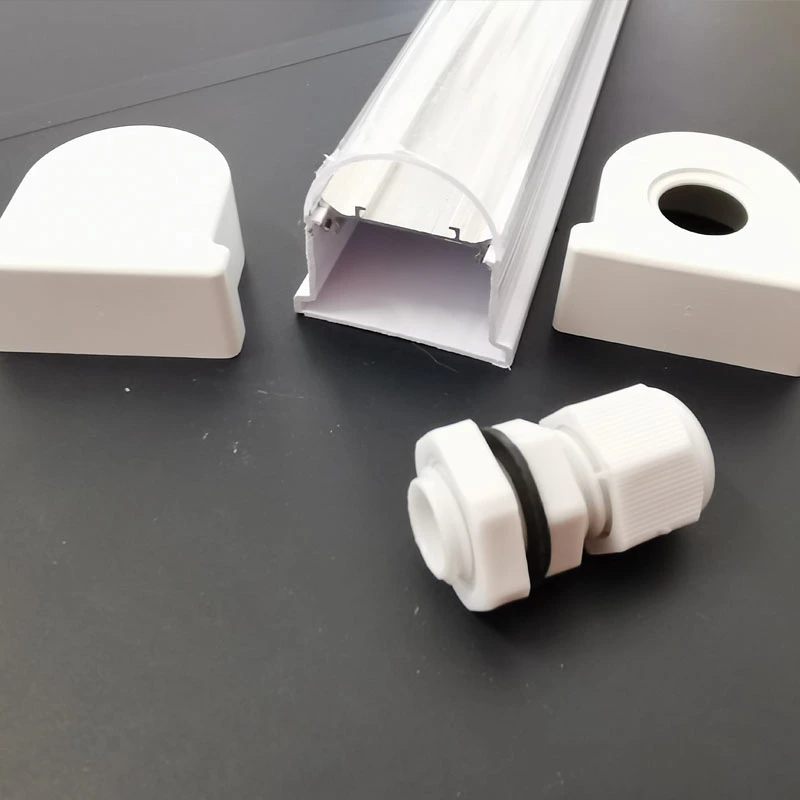
The Production Value of Empty Integrated Housings
Buying empty integrated housings gives lighting manufacturers absolute control over their internal bill of materials. Instead of importing finished, white-labeled tubes with locked-in specifications, you import the mechanical chassis.
This separation of mechanical and electrical components solves several manufacturing bottlenecks. You can standardize your physical footprint while offering vastly different performance tiers to your buyers. A single extruded profile can house a standard 120 lm/W rigid strip for general parking garages, or a high-CRI, specialized spectrum board for agricultural inspection bays. The external dimensions, mounting brackets, and end-cap sealing procedures remain identical.
Procuring LED T8 integrated tube housing wholesale directly from a specialized extrusion manufacturer like JE also insulates your supply chain. You control the LED binning, the driver selection, and the final assembly tolerances locally. The manufacturer handles the complex plastic and aluminum co-extrusion. This limits your exposure to component shortages, as you are not waiting on a third party to source drivers just to get your housings shipped.
Engineering Features That Accelerate Fixture Assembly
The difference between a profitable assembly run and a delayed one usually comes down to the physical tolerances of the housing. Parts must mate predictably. When extrusions vary by fractions of a millimeter from batch to batch, assembly times spike and IP65 failure rates climb.
Snap-Fit Tolerances and 10mm PCB Track Compatibility
Traditional tube assembly requires sliding a long, flexible diffuser through a channel, often resulting in scratching or binding. A precision snap-fit design eliminates this entirely. By engineering the polycarbonate cover to clip downward into the aluminum base under specific pressure, operators can lay the cover over the populated board and lock it sequentially down the line.
This design relies on tight control over the locking ridges. If the ridges are too shallow, the cover detaches under thermal expansion. If they are too thick, operators cannot close the fixture without pneumatic tools. JE calibrates these profiles so the cover seals tightly enough to compress the internal silicone gaskets, achieving an IP65 waterproof rating without requiring secondary liquid adhesives.
Internally, the channel geometry is just as critical. Standardizing on a T8 integrated housing for 10mm PCB tracks allows assemblers to use widely available rigid FR4 or aluminum-backed LED boards. A precision 10mm track holds the board via friction and mechanical lips. You skip the thermal tape entirely. The board slides in, makes direct contact with the cooling surface, and stays locked during transit.
Plastic-Clad Aluminum for Structural and Thermal Integrity
Pure plastic tubes warp. Over a standard 4-foot or 8-foot span, the heat from commercial drivers and high-output LEDs softens pure polycarbonate or ABS, causing the center of the fixture to sag. Conversely, pure aluminum housings require elaborate, multi-part end caps to isolate the internal electronics from moisture, which introduces multiple potential points of failure.
The solution is plastic-clad aluminum extrusion. This process bonds a rigid 6063 aluminum internal heat sink directly inside a continuous polycarbonate or PMMA outer shell during the extrusion phase. The materials cool together, forming a single unified profile.
The benefits on the assembly line are immediate. You get the thermal dissipation coefficient of an aluminum core—pulling heat away from the 10mm PCB track to extend diode life—wrapped in a continuous dielectric barrier. Because the outer shell is a single, uninterrupted piece of plastic, water cannot bypass the sides. You only have to seal the two ends. This drastically reduces the labor required to build a reliable IP65 waterproof T8 integrated housing.
Deploying Damp-Location T8 Profiles in Commercial Sectors
Standard indoor T8 profiles fail rapidly in commercial environments where humidity, dust, and temperature swings are the norm. Specifying a true damp location T8 LED tube housing ensures the fixture survives its stated warranty period. The operating environment dictates the exact housing configuration.
Agricultural Facilities and 2026 IoT Sensor Integration
Greenhouses and indoor vertical farms present a brutal operating environment for lighting. Fixtures face high ambient temperatures, constant humidity, and routine exposure to aerosolized fertilizers and chemical sprays. A standard aluminum profile will oxidize and pit under these conditions.
A T8 integrated greenhouse lighting housing utilizing an all-plastic exterior resists chemical degradation. Furthermore, agricultural lighting is shifting rapidly toward automated control. By 2026, the baseline expectation for commercial grow operations will include localized IoT sensors—measuring photosynthetically active radiation (PAR), ambient temperature, and occupancy—embedded directly into the lighting grid.
Integrated T8 housings offer the internal volume necessary to mount these micro-sensors alongside the driver. The snap-fit PC cover allows specific sections of the diffuser to be modified or drilled to expose sensor nodes without compromising the structural integrity of the main aluminum chassis.
Industrial Washdown and Parking Garage Environments
In food processing facilities and commercial car washes, fixtures are subjected to high-pressure water jets and harsh cleaning agents. Glass tubes are strictly prohibited due to shatter risks. Here, a thick-walled plastic-clad aluminum T8 extrusion is mandatory.
Parking garages present a different failure mode: cyclic thermal loading. Temperatures can swing forty degrees from day to night. Polycarbonate and aluminum have different coefficients of thermal expansion. If the housing is not engineered to accommodate this differential movement, the end-cap seals will shear over time, allowing moisture into the driver cavity. JE accounts for this expansion delta in the extrusion tooling, ensuring the snap-fit T8 LED aluminum profile maintains its IP65 rating even after years of seasonal temperature shifts.
Material Selection and Optical Testing for PC Diffusers
The cover material dictates both the mechanical durability and the photometric performance of the final fixture. While PMMA (acrylic) offers high light transmittance and resists UV yellowing, it is brittle. For most industrial and commercial integrated T8s, polycarbonate (PC) is the required standard due to its high impact resistance.
However, you cannot simply specify "frosted PC" and expect consistent lighting. The density of the diffusion material affects the color temperature (CCT) and the lumen output of your LEDs. A poorly formulated milky cover can shift a 4000K LED strip down to 3800K, or trap 20% of your light output inside the tube.
This is why rigorous integrating sphere testing is a non-negotiable step in extrusion manufacturing. JE tests clear PC cover T8 integrated profiles, frosted variants, and ribbed diffusers inside an integrating sphere to map exactly how the extrusion alters the raw LED output. This data allows OEM buyers to adjust their internal LED binning before mass assembly, rather than discovering a CCT shift after the fixtures are built.
Transitioning from Prototype to Volume Manufacturing with JE
Moving from a proof-of-concept fixture to a reliable assembly line requires an extrusion partner that understands B2B lighting requirements. Off-the-shelf profiles work for standard jobs, but large-scale commercial contracts often demand specific modifications—a wider internal driver cavity, a distinct mounting flange, or an altered diffuser transmission rate.
JE maintains hundreds of existing mold designs, covering everything from standard T5 and T8 shapes to massive T12 profiles. If your project parameters fit within an existing design, you bypass tooling costs and move straight to testing. If the job requires a custom LED T8 integrated fixture housing, our engineering team handles the ODM/OEM process from initial CAD validation through die cutting, thermal modeling, and final extrusion.
Stop fighting poorly toleranced parts on your assembly line. Evaluate the mechanical chassis before you commit to a build. Review the technical specifications for our LED T8 integrated housings and see how exact extrusion tolerances can accelerate your production schedule.
Previous:LED Tube Waterproof End Caps